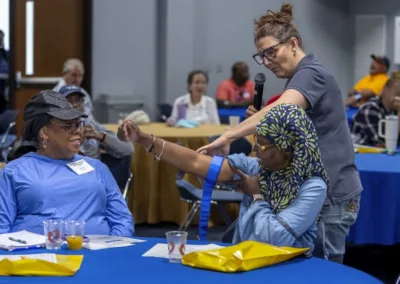
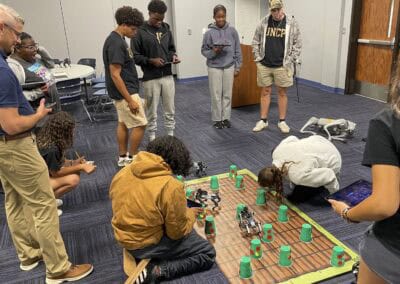
CHARLOTTE – Community leaders and volunteers from across North Carolina will convene Oct. 17 in Charlotte for the annual Grassroots Leadership Conference (GLC), a one-day event to discuss local issues and develop strategies for positive change.
The 2023 GLC will run from 8:30 a.m. to 3:30 p.m. at the Harris Conference Center, 3216 CPCC Harris Campus Drive — the first time the event will take place in Charlotte since its inception in the early 2000s. The program is offered every year by Cooperative Extension at N.C. A&T State University. The GLC is free and open to the public, however, advance registration is required by Oct. 9 at http://bit.ly/grass23.
With the theme Promoting Economic Well-Being Through Grassroots Innovation, this year’s conference focuses on economic empowerment and innovation at the grassroots level and what community members can do to find solutions that address local needs and challenges. Each year, the GLC brings together elected and civic leaders, volunteers, Extension professionals and audiences, farmers and business owners to brainstorm on grassroots community development ideas. With the conference in the state’s largest city this year, organizers will seek to engage urban communities and leaders and show how Extension programs can promote positive change in urban communities.
“In urban areas, the neighborhood is the grassroots level, and we want to show that people can make an impact there,” said Michelle Eley, Ph.D., community and rural development specialist with Cooperative Extension at N.C. A&T. “Many of the same problems, such as food insecurity, affect these areas. As always, we want to empower people who haven’t been at the decision-making table and help them think about the issues important to them.”
Mecklenburg County government is co-host of this year’s conference. Barbara Worley, Ph.D., Extension director in the county, said the conference will provide an inclusive environment for grassroots leaders and community members to discuss urban needs, issues and opportunities.
“In the Charlotte metro area and Mecklenburg County, there’s a great need to engage communities through culture-centered and culturally responsive communication,” said Worley. “That’s how we establish trust and build strong collaborative and cooperative partnerships. This conference is a wonderful opportunity to foster those partnerships.”
Tawanna A. Black, founder and chief executive officer of the Center for Economic Inclusion in St. Paul, will kick off the conference with a keynote address. Black is an expert on creating and executing strategies that benefit diverse workers, consumers, and business owners and drive growth and fiscal health. Her organization works to promote racially inclusive and equitable regional economic growth in cities across the country. She works with businesses and government agencies to create strategies for shared economic growth that empower employees, build trust among stakeholders, and create positive community impacts.
The conference will also feature workshop discussions on a wide range of issues important to urban and rural grassroots leaders and community organizers, including:
- Preserving open spaces in the midst of urban expansion.
- Finding support to launch and grow a small business.
- Using lessons learned to become a better change agent.
- Exploring pathways to economic inclusion and mobility.
- Developing plans for urban agriculture and production.
- Achieving grassroots change through community partnerships.
“A lot of things happen at the grassroots level, even in a powerhouse city like Charlotte,” said Eley. “It’s not just people with power doing economic development. We look at ways that communities can create their own solutions to address their needs and empower diverse voices.”
The GLC will also feature a vendor exposition and networking lunch, where Extension and partner organizations, including the Conservation Fund, the Federal Deposit Insurance Corporation (FDIC) and the North Carolina Community Foundation, will share information and interact informally with conference participants.
This year will also feature a pre-conference reception for local community and business leaders from 4:30 p.m. to 7 p.m. on Monday, Oct. 16. Called Dialoging With a Purpose, the event will give Extension staff the chance to network with local stakeholders and discuss their vision for urban Extension programming.
“The reception is to get feedback and let people know we are here,” said Eley. “We want to listen, showcase what Extension can do, and talk about our vision for programs in urban spaces.”
For more information
Please contact Eley or Renee Campbell at 336-334-7956.