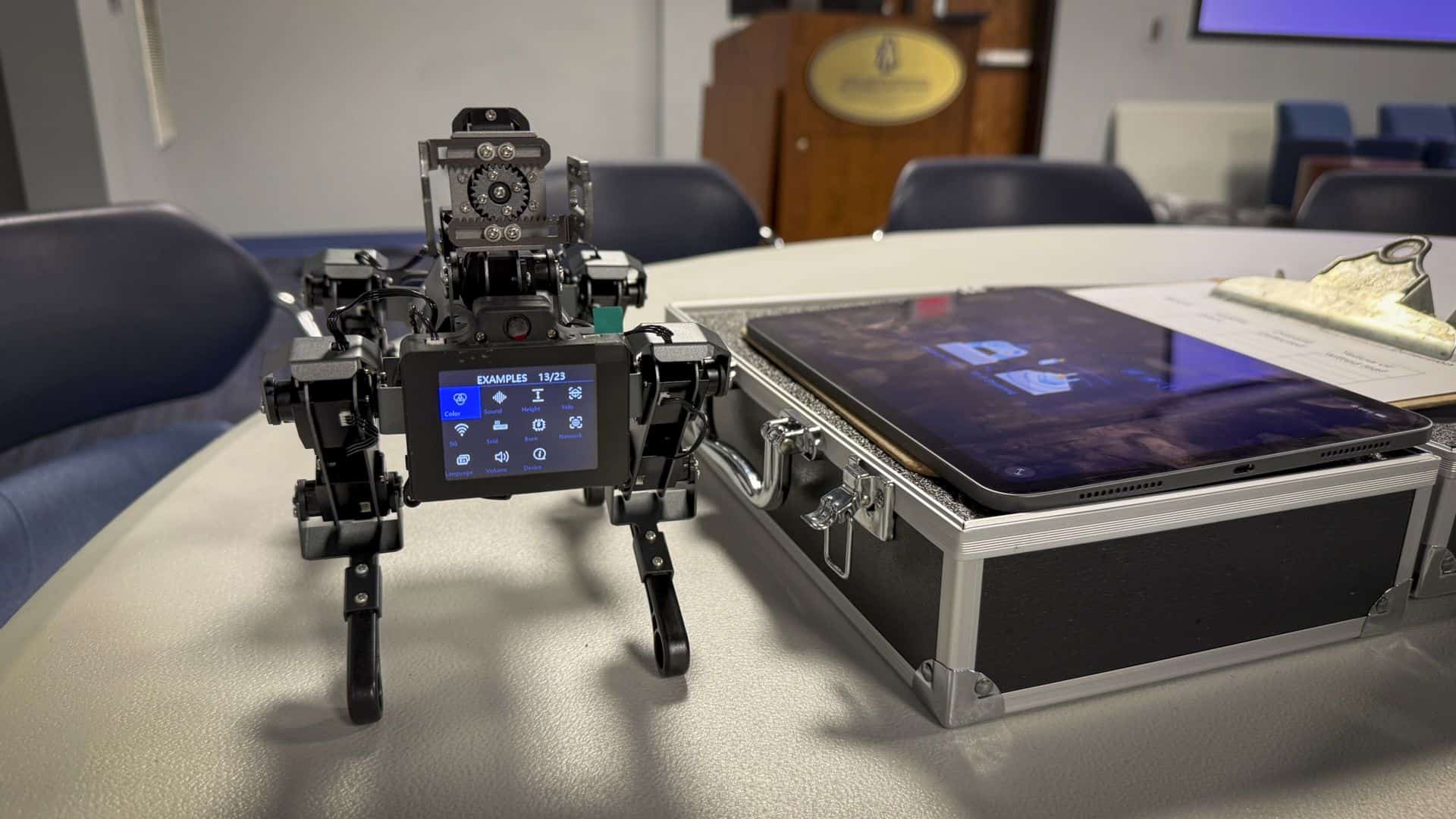
Make room for the robotic “pups.” Thirty-two of them, to be exact.
The XGO-Lite robots were an instant hit on their first time in the field, operated by high school students from UNC-Pembroke’s Safeguarding our Natural Heritage summer camp.
“Just the fact that we were able to control them, it was a very fun experience,” said Jabari Mwamba, a student at Seventy-First High School in Fayetteville, North Carolina.
That personal interactivity is important, said Mark Light, Ph.D., an Extension 4-H STEM (Science, Technology, Engineering and Math) specialist.
“This purchase came about after we purchased the industrial robot dog,” Light said, referring to the larger robot that is being coded to identify insects, plant diseases and weeds in farm fields.
“We wanted youth to have a more hands-on approach, so that they can try out the technology and mimic what goes on in the field,” Light said.
For the high school students, he set up a mock tomato field inside the pavilion at the N.C. A&T State University Farm. He used a vinyl pad printed with brown rows for the field and plastic cups covered with colored bits of paper to represent the plants.
The high school students directed the small robotic dogs — which stand about 6-1/2 inches tall — onto the pad to search for “sick plants.” The robots were coded to recognize the individual colors of the bits of paper, with green representing healthy leaves, red as tomatoes, yellow as distressed leaves and blue as diseased leaves.
Light pointed out that one student’s robot that too far away from the cups and was instead focusing on the red tones in the brown color of the pad. “You’ve got to teach the robot ‘this is what a bird looks like,’ ‘this is what a tomato looks like,’ ‘this is what a leaf looks like,’” he told the students. “Otherwise, it doesn’t know the difference.
“You see how some data could be false data because it’s saying there’s a tomato, but it’s finding the ground instead of finding the plant,” Light said, noting that that is why scientific trials are necessary to ensure correct findings.
“We still need humans alongside tech for coding, for programming, for interpreting the data,” Light said.
Raymond Fountain, a student at PSRC Early College at Robeson Community College, said he’s always been interested in robotics and participates in the school’s robotics team.
“But I never realized how much you can be involved in the agricultural field, which really does open new opportunities and ideas,” Fountain said. “Now I can see how (robotics) works in other applications.”
Aside from agricultural possibilities, Light noted that robots also can assist people with disabilities or police officers with investigating suspicious packages.
Reflecting on “The Jetsons” cartoon series of the 1960s, Light said characters like Astro the dog and Rosie the housekeeper forecast the possible benefits of robots. “That's always been science fiction and fantasy, and now we're seeing those kinds of things come to fruition,” he said.