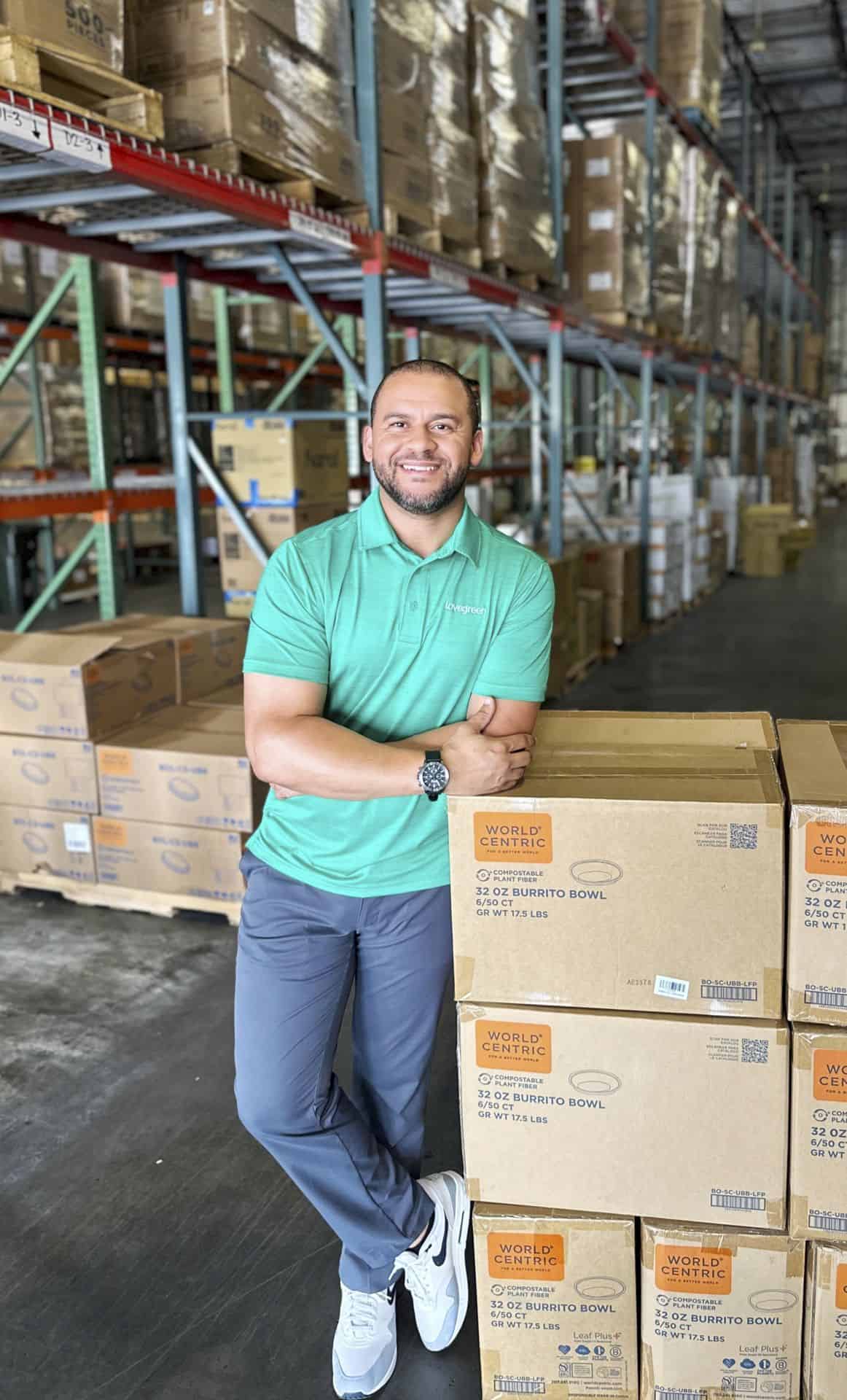
N.C. A&T alumnus Brian Dockery’s first “warehouse” for his distribution company was his bedroom. And his initial budget? Only $500.
That was in June 2020. Today, Dockery’s business, The LoveGreen Co., is multimillion-dollar company that supplies governments, restaurants, healthcare and other facilities with straws, utensils, cups and food containers made from plant-based materials.
How did that happen? Vision and principles, Dockery ’05 told students gathered on Zoom for the Fall 2026 CAES Student Professional Development series kickoff.
“I want you to create principles for your life that you live by, because things are inevitably going to change. Chaos is bound to happen,” he said.
Dockery started Texas-based company after he was let go from an Australian biotech company.
“If you live by principles, those principles don't change, and those principles are going to keep you in alignment, and they're going to push you towards your vision when everything else around you doesn't look like the vision that you have for your life,” he said.
In his case, Dockery said his principals are centered around building wealth, having a family and living with integrity — all with God’s will, love for others and optimal health in mind. His vision: to exemplify love in everything he does.
By reducing or diverting waste from landfills, waterways and the ocean, Dockery said, his company is a vessel that allows him to supply love to the planet. “It’s not just a business, it’s a conduit by which we serve people.”
Ocean Conservancy estimates that eliminating five commonly used plastic products, including straws, cutlery and foam food containers, could reduce plastic use in the United States by roughly 1.4 million tons, or 2.8 billion pounds, annually.
“Consumers today expect sustainability, so this is one of the needs that we are meeting and this is how we are using agriculture to do it,” Dockery said. Filling that need channels his own purpose to serve others.

Brian Dockery marched in the Blue and Gold Marching Machine from 2001-2004 as a sousaphone player.
“He cared about me and kind of took me under his wing,” said Dockery, whose friendship with Alston has continued since Dockery’s high school agriculture teacher introduced them.
The agricultural profession offers broad opportunities, said Dockery, who recalls sitting on a tractor fender at his grandfather’s farm in eastern North Carolina.
“Those were some of the best times of my life,” he said. “But today’s agriculture is so much different and so much more advanced. It’s marked by the onset of technology to expand the yield on crops to feed a growing population.”
Food is only one product coming from the field; cops are being processed into other things as well, Dockery said, noting that some of the products he distributes are made from a corn-based resin and upcycled sugar cane fiber.
His parting suggestion to students was to know what their purpose is.
“It’s who you are. It’s not a job. It’s not a position. It’s not a building,” Dockery said. “Your purpose is going to be rooted in fulfillment and serving a cause bigger than yourself.
"Get with your staff and your professors at A&T, they care about you. Get experience, internships, opportunities, travel abroad. Maximize every opportunity you have at A&T because once that opportunity is gone, it’s gone.”