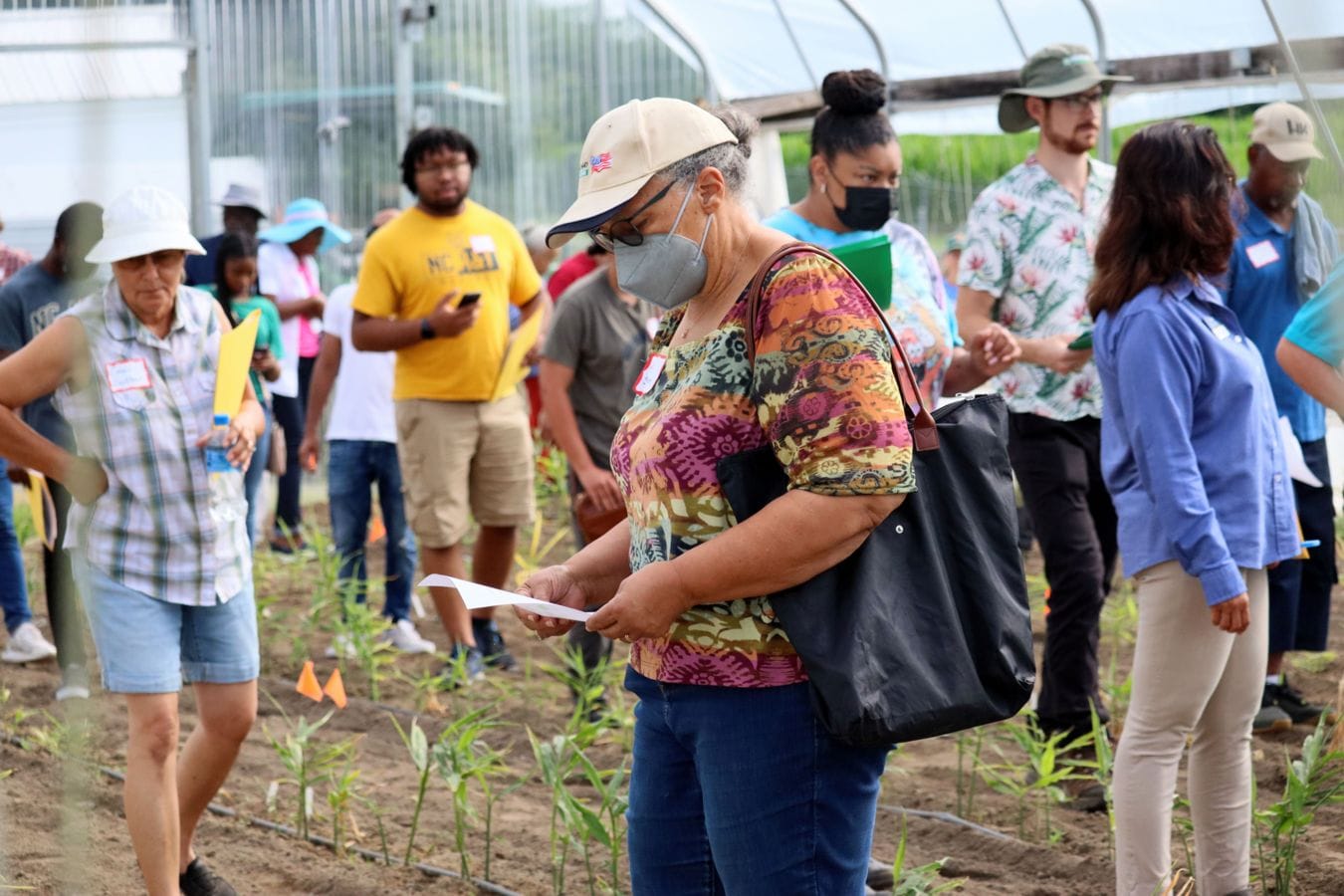
Growers and agricultural professionals from across North Carolina examine high-tunnel ginger during this year’s Small Farms Field Day on June 23.
More than 150 farmers, growers and other agriculture professionals came to the University Farm for the first time in two years to learn techniques, see demonstrations and hear updates from the College of Agriculture and Environmental Sciences and N.C. A&T Cooperative Extension during Small Farms Field Day, held June 23.
The field day, making its return as an in-person event this year following two years as a virtual event during the COVID pandemic, offered concurrent sessions of organic and conventional field demonstrations from university and Extension professionals.
“We’ve been making sure you have practical knowledge that you can use in your operation,” Extension horticulture specialist Sanjun Gu, Ph.D. told the crowd in opening the event. “This is for you, the small farmer, so that you can apply Aggie know-how to boost your bottom line.”
Shirley Hymon-Parker, Ph.D., associate dean for research, highlighted the college’s expanding research portfolio, now at $34 million.
“Given that every dollar spent on research returns $20 to the economy, farming’s future looks bright. But we can’t stop,” she said. “We’re working to make sure farming remains a viable career option for youth today.”
Two varieties of bamboo, one of the state’s emerging crops, were on display on the conventional field tour. Planted four years ago, shoots from the bamboo on the one-acre plot should be ready for harvesting next spring, said Robert Stevenson of commercial bamboo farming company OnlyMoso, which is partnering with the college. Bamboo can be harvested all over the U.S. and used in its entirety, Stevenson said.
“Bamboo can be a new and sustainable income stream for farmers,” Stevenson said, “Bamboo has uses in construction, such as flooring and furniture; as biofuel; it supports soil structure and prevents erosion; and the shoots can be used as food or in tea.”
Participants also got a look at tomatoes and watermelons grown in the field using pigmented plastics and degradable mulch and at the structure and design of several kinds of high tunnels, temporary greenhouse-like structures that extend the growing season by protecting crops from wind or extreme temperatures.

Types of Asian melons were on display during the organic field tour.
On the organic field tour, Gu highlighted one of the university’s prominent research projects: ginger production and how micropropagation - “test tube plants” - can increase productivity and profit.
“We’re trying to solve a problem in ginger production,” said Gu. “Right now, most seeds are from Hawaii. So, if they have trouble, we have trouble.”
According to Gu, ginger production in Hawaii can only meet 20 percent of demand in the United States, with the remaining 80 percent imported from other countries. To increase production for North Carolina and other mainland states, the research team – including researchers Julia Robinson, William Lashley, Gu and Gouchen Yang, Ph.D. – has developed a micropropagation protocol to produce ginger seedlings in high tunnels.
“We did some tissue culture trials last year,” said Gu, referring to a map designating each bed. “For Tissue Culture F1, for example, even though the yield looks small, by the end of the season, their yield is comparable to a regular commercial source.”
Another project demonstrated by Gu and assistant Peter Coffey was the field’s ethnic vegetables. Niche crops like winter melon, bitter melon, luffa and specialty melons, according to Gu, are the result of an increased demand for Asian vegetables in metropolitan areas such as the Research Triangle, Greensboro and Charlotte, driven by an equally increased population of people from China, India and other southeast Asian countries.
“We just wanted to do something before it (the population growth) really happens,” said Gu, passing around freshly pruned luffa and winter melon as examples. “It’s good for everybody, but it’s also good for Asian Americans.”