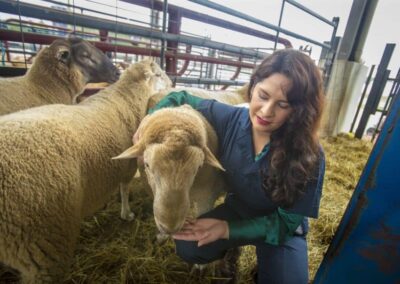
As a laboratory animal science major, N.C. A&T senior D’Karia Bascom will spend her fall semester in Webb Hall, navigating the courses she needs to complete her degree.
But she spent this past summer studying the foraging habits of a different type of animal - fish - as a participant in the University of California, Los Angeles’s The Diversity Project, a research-intensive educational program designed to increase the participation of underrepresented minority students in marine biology and conservation fields.
The Diversity Project began in 2005 as a research and mentoring experience supported by funding from the UC-HBCU initiative, the National Science Foundation, and the National Philanthropic Trust. To her knowledge, Bascom is the first N.C. A&T student to attend the program.
 “That feels amazing to know, because the program has been running for almost 20 years,” said Bascom. “This program is so critical because there are not a lot of pathways into a Ph.D. program, particularly for marine biology, for people who look like me.”
"Marine ecosystems are facing unprecedented environmental challenges worldwide,” said Paul Barber, Ph.D., a UCLA professor and director of the program. “Addressing these challenges requires talented marine scientists who can bring a diversity of thought and experience to promote sustainability of these vital ecosystems. The Diversity Project was started to develop these leaders. D’Karia is one of these future leaders and we look forward to seeing her career develop, and how she will impact the world with her science.”
For Bascom - a Pensacola. Fla. native, who fell in love with marine biology partly because of her favorite childhood movie, Finding Nemo - the 10 weeks she spent on the UCLA campus and the island of Mo’orea, in French Polynesia, helped bring a lifelong interest one step closer to being a career.
Bascom found out about the program in Nov. 2023, when she attended the non-profit Black in Marine Science (BIMS)’s annual conference and met UCLA Diversity Project alumni. She applied to the program and was accepted.
She spent most of her time at the university’s Gump South Pacific Research Station on Mo’orea, examining the relationship between reef complexity and the anti-predatory behavior of the brown surgeonfish, an important fish in the Indo-Pacific Ocean.
“These fish are herbivores, and they play an important ecological role because they eat algae off the reef,” said Bascom. “If fish are scared, they spend too much time running away, which means the algae won’t be eaten and the coral will be thrown off balance.

“We hypothesized that the fish will exhibit more fear in low-complexity reefs, spending more time fleeing and hiding. In contrast, in high-complexity reefs, the surgeonfish will be bolder, using sheltered areas to hide within the reef.”
Bascom started her academic career in 2021 at Wingate University studying environmental biology, but transferred to N.C. A&T the following year to study laboratory animal science.
“I was new to North Carolina when I was at Wingate, and I didn’t feel particularly welcomed while I was at school,” said Bascom. “My mom started telling me about A&T and said their animal science department would be an easy way to transition to marine biology when I enter graduate school, while also receiving an HBCU experience.”
The move paid off, Bascom said. During her time at A&T, she has joined programs the Earth and Environmental Science Club and MANRRS (Minorities in Agriculture, Natural Resources and Related Sciences).
“My department has definitely poured a lot into me,” said Bascom “I’ve been able to benefit from the resources that I have so I’m able to do laboratory animal science at school, while still studying marine science on the side.”