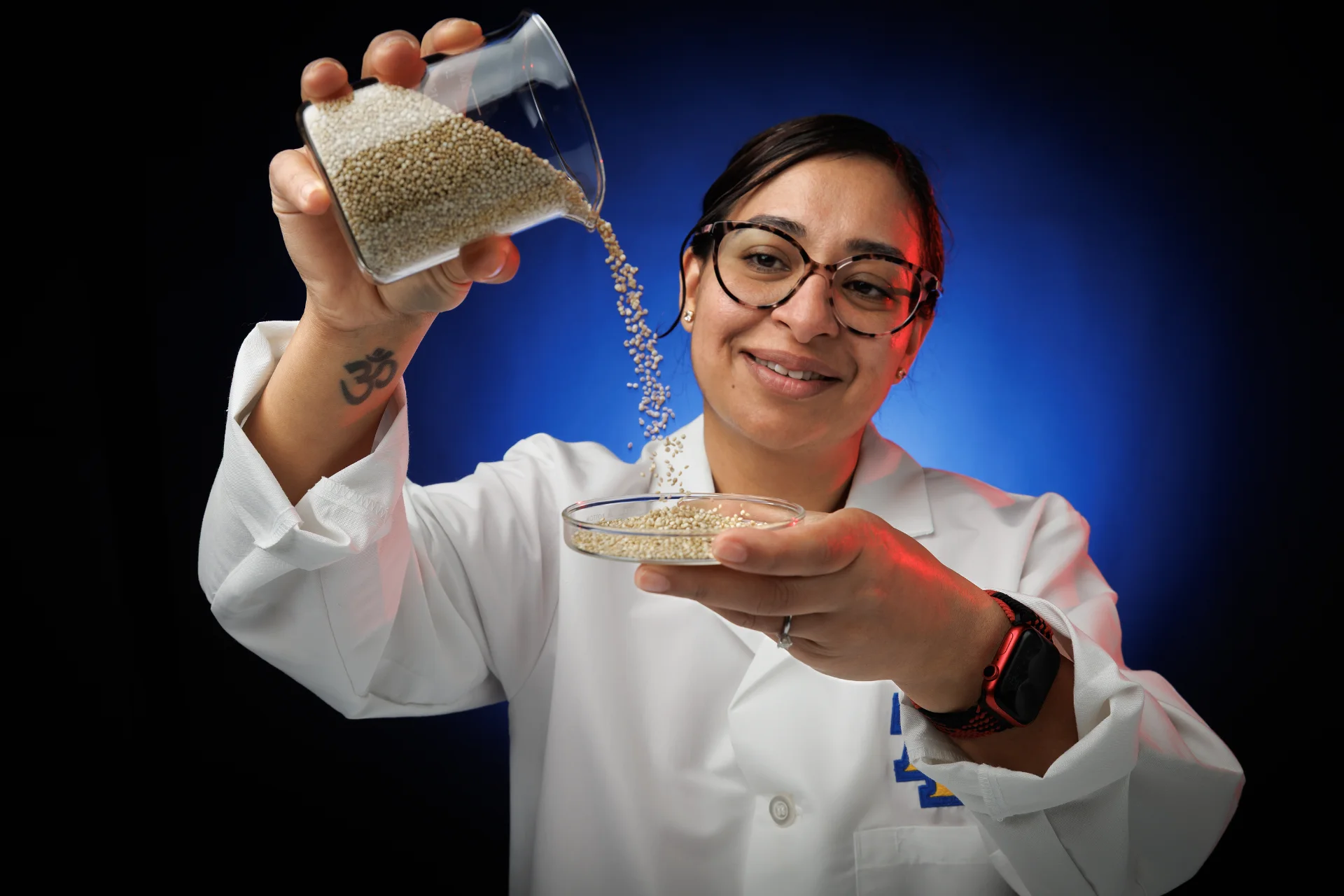
North Carolina Agricultural and Technical State University will collaborate with another Historically Black College and University in the Midwest to apply cutting-edge technologies that could improve the yield and quality of a trendy ancient grain.
Harmandeep Sharma, Ph.D., a research assistant professor in crop science and digital agriculture, is the co-principal investigator on a new project to study quinoa. N.C. A&T will receive a portion of the project funding, which is supplied from a $599,723 grant from the U.S. Department of Agriculture’s 1890 Institution Capacity Building Grants Program.
The project is based at Lincoln University of Missouri and is led by Addissu Ayele, Ph.D., an assistant professor of crop physiology with the Lincoln University Cooperative Research Program.
“This high-tech and impactful project is yet another example of the tremendous potential of collaboration between two 1890s universities,” said Radiah Minor, Ph.D., interim dean of the College of Agriculture and Environmental Sciences at N.C. A&T. “Agricultural research is central to the mission of land-grant institutions. This project will go even further by educating farmers on the best ways to grow quinoa and training the next generation of agriculture professionals.”
Researchers at these two universities will study quinoa (pronounced “KEEN-wah”), a nutrient-rich plant whose edible seeds are high in protein, amino acids and dietary fiber. It is considered an ancient grain because it has been grown for millennia in mountainous regions in South America. More recently, it gained popularity among health-conscious consumers as a highly nutritious and gluten-free superfood. Because quinoa was not grown in the United States until the 1980s and remains a specialty crop, there is little information on crop management practices for domestic growers.
This joint project will involve parallel investigations at both universities, where researchers will study the same drought-tolerant variety of quinoa identified by previous Lincoln University studies. Sharma will grow quinoa at the N.C. A&T University Farm, apply different mixtures of nitrogen, phosphorus and potassium, and collect data from multiple drone-mounted cameras and ground-based sensors to measure and predict growth and development patterns, seed yield and nutritional quality.
The project seeks to evaluate the effects of different amounts and timing of fertilizer applications on seed yield and quality. It also will test different drone-mounted cameras to determine the most efficient method for rapidly and automatically collecting data and predicting traits of quinoa plants as they grow. In addition, the project will analyze the costs of various fertilizer applications to determine the profit potential of growing quinoa. The project teams plan to conduct workshops and training sessions for farmers and extension agents and establish internships and exchange programs between the two institutions for students interested in agriculture.
“This project presents a great opportunity to evaluate quinoa as a potential crop for small-scale farmers in North Carolina,” Sharma said. “Our comprehensive 360-degree approach ensures that we capture all critical factors and provide well-informed and actionable recommendations to support our stakeholders and farming communities.”