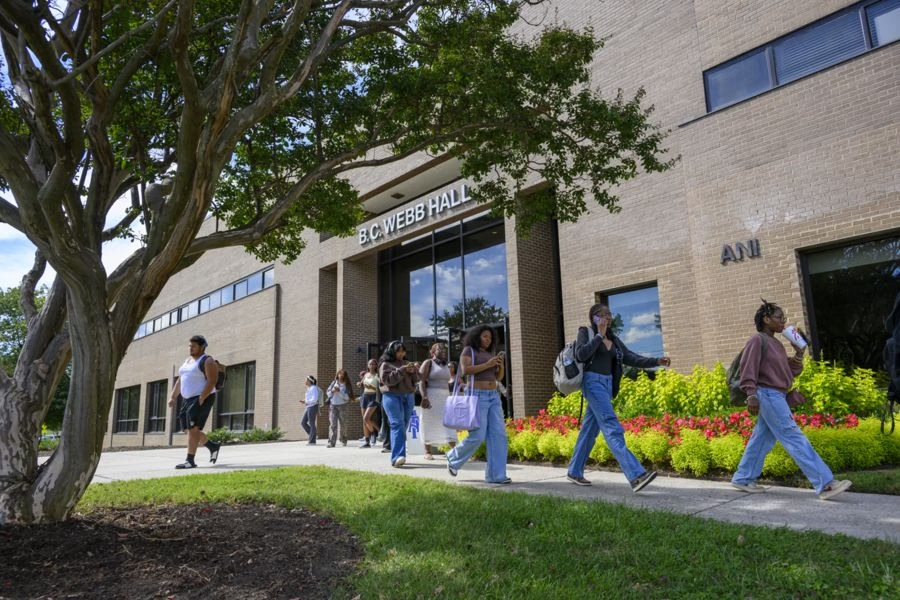
The College of Agriculture an Environmental Sciences achieved record enrollment growth this fall, with 1,271 students enrolled across all programs and 56 students in the Ph.D. program.
Those numbers mark the largest student body in the college’s 134-year history and an increase of 118 students from Fall ’24, when 1,153 students enrolled in the college. From the smallest programs to the largest, all showed enrollment gains, according to college leaders.
“It’s the Aggie brand,” said Antoine Alston, Ph.D., associate dean for academic studies. “People understand that we represent high quality, innovation and community impact. We have a vision for the future of environmental sciences, food science and agriculture. People see that.”
The largest undergraduate gains came in the animal sciences programs, the agricultural education program and the Agriculture and Environmental Systems – Sustainable Land and Food Systems majors, Alston said. Growth in the graduate program is fueled by the Ph.D. program, which launched in fall 2022 with 10 students and is now at 56, a 460 percent increase in three years.
That growth is fueling the university’s drive to achieve an R1, or very high, research activity status, a coveted classification for doctoral universities, Alston said. This fall, the program will graduate its first “three-time Aggie,” a student who has received all three degrees from N.C. A&T, as well as its first Ph.D. in the Agribusiness and Applied Economics concentration.
Two other Ph.D. students, the college’s very first, graduated in spring and summer 2025 with concentrations in the Food Science, Human Nutrition and Health and the Sustainable Agriculture and Environmental Sciences concentrations, respectively.
“These gains show that the college is highly visible and highly committed to student success,” said Radiah C. Minor, Ph.D., interim dean of the college. “We equip our students with the knowledge, skills and dispositions that they need to be leaders and entrepreneurs, and in the college ‘where science meets society,’ we teach them to use that knowledge to go into the world and improve the human condition.”
The college has intentionally overhauled its curriculum to reflect current issues and need-to-know trends in agriculture, food and nutritional science and other program areas, Alston said. The college’s student body also reflects a wide array of North Carolina counties, across the country and countries around the world.
“There’s an experiential component to our college,” he said. “We make sure our students get the internships, have the study abroad experiences or community work and are able to create their own networks, making friends with people from across the country and the world. They take an expanded network with them after graduation.”
The enrollment gains parallel those of the university, which this fall enrolled 15,275 students for the first time, a record not only for A&T but for historically Black college or universities (HBCUs) nationwide.
This is the 12th consecutive year that A&T has been the nation’s largest public HBCU.