CaesNews

Where Science Meets Society

Logo featuring the letters "A" and "T" in blue and gold, representing North Carolina Agricultural and Technical State University.

CaesNews

Where Science Meets Society

Home

Sign up for the Newsletter

January 2022 News and Notes

|

All About Hemp is all you need to grow 

N.C. regulations changed Jan. 1! Stay ahead of the curve with All About Hemp, the comprehensive hemp growers’ guide from N.C. Cooperative Extension.  Order from you county Extension office or from N.C. A&T’s horticulture experts Sanjun Gu, Ph.D. and Randy Fulk, horticulture associate: sgu@ncat.edu or rafulk@ncat.edu.  

Huchette, Urban Food Platform featured in international magazine
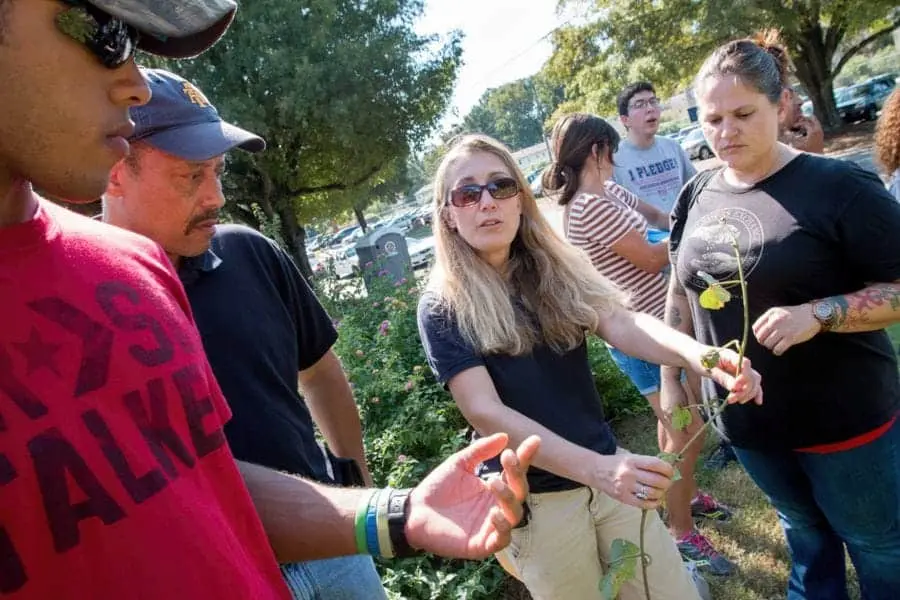
Horticulture lecturer Odile Huchette works with a group of students and community gardeners. She and the horticulture program were featured in Futurum Careers, an international magazine, to raise awareness about careers in horticultural fields. 

Odile Huchette, the lecturer in the Department of Natural Resources and Environmental Design, brought N.C. A&T students’ experiences with the Urban Food Platform to other students around the world recently with the help of Futurum Careers.

Futurum is free online resource and magazine designed to introduce 14-19 year olds worldwide to STEM careers. The CAES program was featured in a recent issue of the magazine.

“With rural communities shrinking and urban and suburban populations growing, a lot of students coming into agricultural sciences have little practical experience in horticulture and food production,” Huchette told the magazine. “It is important to include experiential learning and develop programmes that are relevant to urban and suburban students.”

In the Urban Food Platform, students conduct scientific research, collecting crop and climatic data from sowing to harvest, and manage all aspects of urban food production in a working horticulture space that contains a greenhouse, raised beds, cold frames and hydroponics. Students also organise outreach activities to engage the campus and wider local community with the campus.


Would you like to learn more about N.C. A&T State University?

Founded in 1891 in Greensboro, North Carolina, N.C. A&T is the nation’s largest historically Black university and a premier 1890 land-grant doctoral research institution. Home to more than 14,000 students, A&T is nationally recognized as the top public HBCU in the country and the number one producer of Black graduates in engineering and agriculture. With over $2.4 billion in annual economic impact, the university combines rigorous academics, pioneering research, and a vibrant campus culture to prepare the next generation of global leaders. 

Read more CAES News

News and Notes, March 2024

News and Notes, March 2024

The College of Agriculture and Environmental Sciences renewed its Memorandum of Understanding with the U.S. Environmental Protection Agency this month, pledging to work together to boost opportunities for students at EPA; encourage their participation in EPA programs; make national employment opportunities available to them; and advance environmental education.
N.C. A&T Alumnus Rides Current of Opportunity into Marine Science Career

N.C. A&T Alumnus Rides Current of Opportunity into Marine Science Career

Myles Saunders has barely begun life as an N.C. A&T alumnus — he graduated just a few months ago, with a B.S. in Animal Science. But he’s already creating a wide wake as he builds a career in the field of marine science and conservation.
UNC System Honors McMillan for Teaching Excellence

UNC System Honors McMillan for Teaching Excellence

Valerie J. McMillan, Ph.D., an associate professor of Family and Consumer Sciences in the College of Agriculture and Environmental Sciences, received the University of North Carolina System’s 2019 Board of Governors Award for Excellence in Teaching at commencement on May 11.
Cream of the crop: CAES sophomore receives FFA’s top student honor

Cream of the crop: CAES sophomore receives FFA’s top student honor

As a child, Leila Noufal liked animals but didn’t raise them. She loved agriculture but didn’t live on a farm. Her closest encounter with farming came while in middle school, on the couch, watching a documentary film about sustainable agriculture.
No results found.