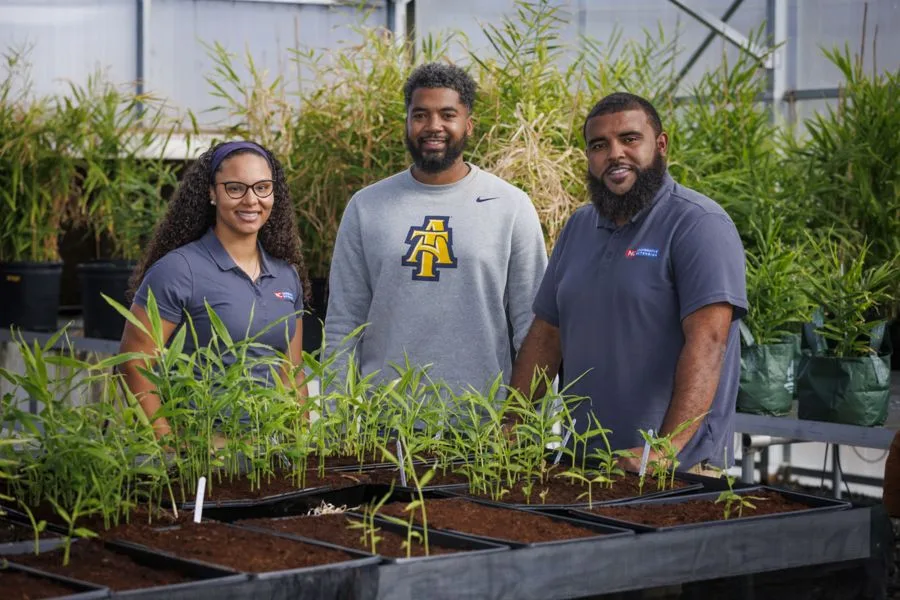
Three first-year students walked into NARS 110 class one day in 2013 and got far more than a lesson in urban and community horticulture. They found a friendship that has sustained them, personally and professionally, throughout their undergraduate years in the College of Agriculture and Environmental Sciences; through their graduate school years, some in other states; to this day, in which all three can call themselves “Dr.”
Ultimately, their connection brought them all back to N.C. A&T to share their knowledge with another generation.
"We all grew up together," William Lashley IV, Ph.D., said of himself, Hannah Talton, D.P.M., and Trequan McGee, Ph.D. “We definitely push each other (to do better) and encourage each other any way we can.”
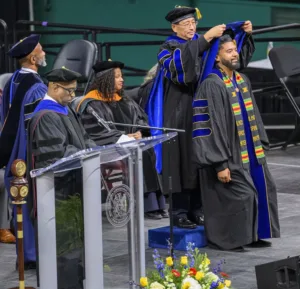
Will Lashley, right, is hooded by his mentor, Guochen Yang, Ph.D., and graduate program coordinator for the Department of Natural Resources and Environmental Design, during the North Carolina Agricultural and Technical State University Fall Graduate Commencement at the First Horizon Coliseum in Greensboro, N.C. Lashley is the first to earn his bachelor’s, master’s, and doctoral degrees from the university’s College of Agricultural and Environmental Sciences.
Often referred to as “Dr. Yang’s kids” after their mentor, Guochen Yang, Ph.D., a horticulture professor in the Department of Natural Resources and Environmental Design, the trio work closely together on ginger research and other projects in the College of Agriculture and Environmental Sciences. Where one is working, there will likely be two – if not all three, sharing their expertise in various ways on the project.
“They are just like siblings,” said Yang, who was named a 2025 “horticultural legend” by the American Society for Horticultural Science. “Personality-wise, they get along really well."
Yang met with each of them weekly during their first four years in college as part of the Multicultural Scholars Program, a rigorous academic scholarship program funded by the U.S. Department of Agriculture and overseen by the patent-winning “HortLegend.”
Unlike many college friends who lose track of each other after going their separate ways, Lashley, Talton and McGee kept in touch— despite the latter two leaving to get their master’s and doctoral degrees at the University of Florida.
“We both went to Florida at the same time and started the master's program — Hannah in entomology, myself in horticulture,” said McGee, now an assistant professor and horticulture specialist at Cooperative Extension at A&T.
Talton, a first-generation college student who switched majors at A&T "two or three times until Dr Yang found me and reeled me in,” said she leaned on McGee when she first arrived at UF.
“It was great to have him there to kind of make sure I was good in that environment — just moving away from home and starting somewhere new,” said Talton, assistant professor and Extension plant pathology and integrated pest management specialist.
After getting their doctorates, McGee and Talton both went to work for private industry before returning to A&T to teach and do research. Lashley, who received his doctorate in December 2025 and is now a research specialist in the Department of Natural Resources and Environmental Design, stayed at A&T and made history as the first person to get a bachelor’s, master’s and doctoral degree from the College of Agriculture and Environmental Sciences - a “Triple Aggie.”
“I remember our conversation about your hair fitting under your master's cap,” Talton teased Lashley. She recalls listening to him practicing his dissertation before presenting it last October. “That was a proud moment for me.”
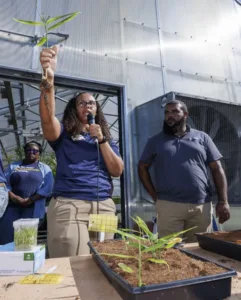
Hannah Talton, Ph.D., assistant professor and plant pathology specialist, speaks during a presentation at Ginger Production Field Day at the North Carolina Agricultural and Technical State University Farm.
Each is aware of the others’ deeper challenges. McGee’s observation that Lashley’s accomplishment went beyond the triple degree.
“The people here watched you go from a bachelor's degree to a master's degree to a Ph.D. That comes with another level of scrutiny because they've watched you this whole time,” McGee told Lashley while congratulating him on his Ph.D.
The trio has quarrels, as well.
“Sometimes, I think it takes us disagreeing on something to align on something,” McGee said. Talton, who describes herself as "the strong, opinionated one,” said their personalities complement each other. "Whenever I have some different ideas, they keep me grounded,” she said.
They also stay in close touch with fellow MSP scholar and graduate, James Martin, whose wedding they attended last year.
“I think one thing that I really appreciated about all three was undoubtedly they were leaders within the department in college,” said Martin, who now works as a regional breeding support specialist for Corteva Agriscience in Kansas. "They weren't leaders by position, but by influence. And I think they were a big part of setting the tone of excellence for the department.”
Amused, he recalls their supportiveness extended to all areas — except for one: ping pong games at the Suds & Duds on Walker Avenue in their early college days.
“It was so weird, how good at ping pong all of them were,” Martin said. “Everything else they’d do just for the sake of developing others, but in ping pong — they played to dominate.”
Looking forward, Lashley, McGee and Talton consider the importance of their mentorship of the next generation of agricultural leaders.
“We find ourselves now thinking about the next folks coming behind us,” McGee said. "Who can we bring into the family and help nurture through grad school? How can we help to bring more folks like ourselves back into the university?”
“I want to pay my due diligence forward,” Lashley said. “I’m itching for knowledge, and whatever I learn, I want to share.”