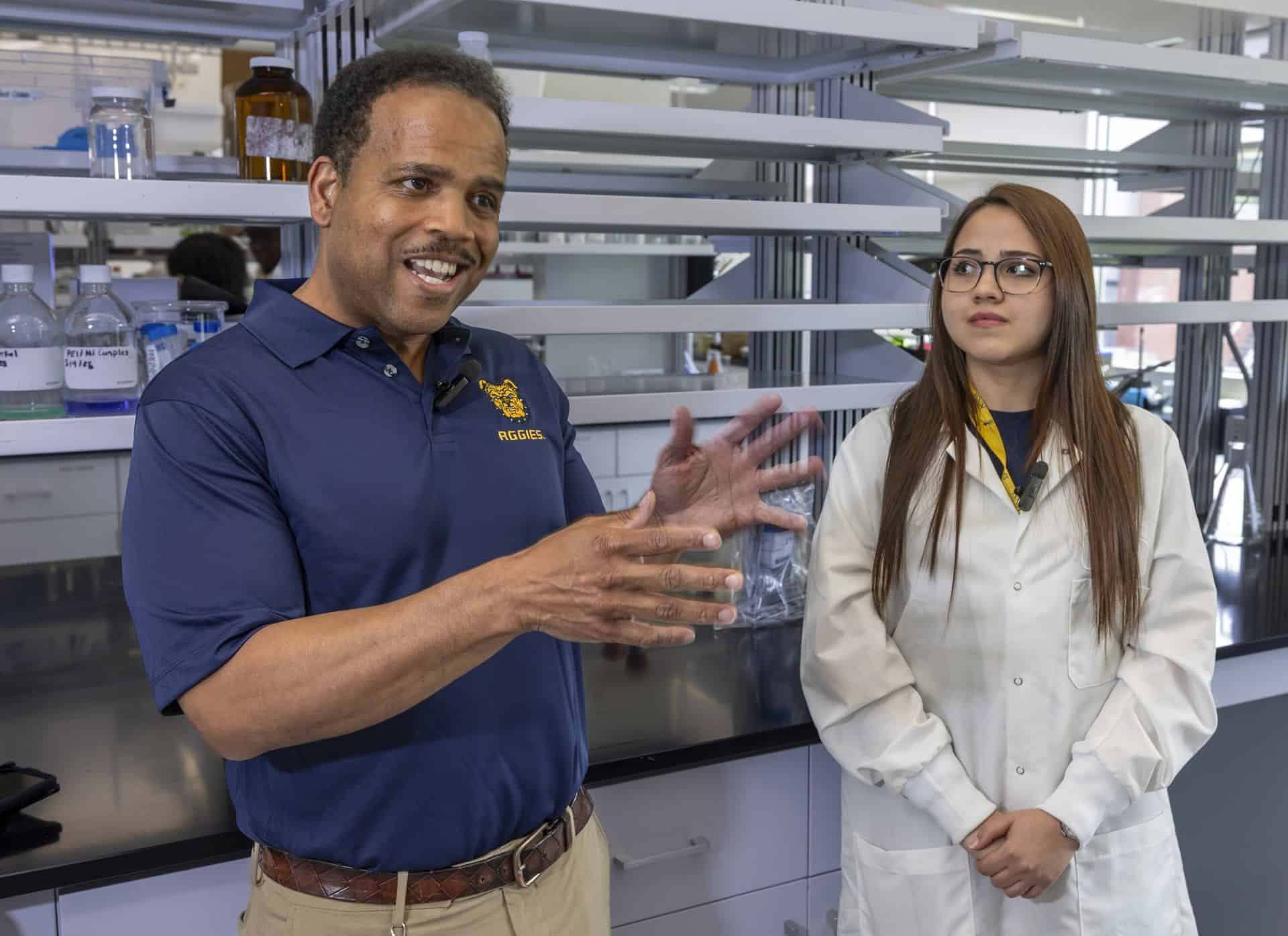
Woundra, an innovative, plant-based wound dressing conceived and designed by N.C. A&T researchers at the Joint School of Nanoscience and Nanoengineering, is moving quickly toward being available at a retail store near you.
The university has filed for the provisional patent for the invention and its team has secured corporate partners and funding, said Michael Curry, Ph.D., graduate curriculum coordinator for nanoengineering.
“We just won a pitch competition from NCInnovation,” Curry said. The team received $25,000 from the statewide public-private partnership designed to accelerate commercialized innovation from North Carolina’s research universities.
Curry said Woundra also has attracted the attention of Anthro Ventures, a healthcare and life sciences investment firm that specializes in supporting medical device companies from clinical development through commercialization. Anthro Ventures will help the team navigate federal regulations in bringing Woundra to market, Curry said. A&T will retain ownership of the technology.
Woundra is attractive because of its particular potential to help people injured on farms or in rural areas — who can’t get immediate medical attention — and to parents of children who have suffered a cut or a burn, Curry said. Emergency responders also could also carry it, he added.
Woundra employs cellulose-based hydrogels engineered for controlled antimicrobial release, cellular safety, and biodegradability. Cellulose are polymers commonly found in plants. Hydrogels are a network of hydrophilic polymer chains that can absorb and retain large amounts of water or biological fluids, forming a soft, gel-like substance.
“Typical wound-healing devices normally only do one thing,” Curry said. “Either they try to control the environment where the wound is being healed, or they are used as a delivery system to deliver these treatment processes.
“The way we designed Woundra was to be a catch-all in one, where you can control the wound healing environment, but also deliver the treatments that you need — the antimicrobials, the antibacterials, the antifungals, or even a semiconductor that has electrical properties that can assist with the wound closing."
Scientists have discovered that wound healing involves tiny electrical signals. Semiconductor-enhanced dressings may help strengthen those signals, giving the body's repair cells clearer instructions on where to go and what to do.
Other ingredients with antimicrobial properties and that encourage healing include Manuka honey, made by bees gathering nectar from the Manuka shrub native to New Zealand and Australia, and chitosan, a natural substance made from chitin that is found in the shells of shrimp, crabs, and other crustaceans.
Melanin and hemp oil, which promote healing, also are being considered for later formulations.
“Because of how we engineered it, it is adaptable to skin types and skin allergies. Someone may be allergic to Manuka honey, but then we can add in hemp oil or something else. That is the beauty of this,” Curry said.
Woundra’s nanoengineered structure will control the level of moisture, he said, noting that wounds heal better in a highly oxygenated and moist environment. The team plans to make it available in the form of an ointment, foam and patch.
The team is incorporating a synthetic material commonly used in medical products —polyvinyl alcohol (PVA), to provide structural strength so the patch won’t easily tear, said Hoda Motaghed, a Joint School of Nanoscience and Nanoengineering doctoral student who leads the research team.
PVA also increases the absorbency of the hydrogels, helping them to stay flexible and maintain their shape while creating a moist environment that supports healing.
Initially, Woundra will be rolled out as an over-the-counter product using only the hydrogel, which naturally has some antimicrobial properties. Curry estimated that could happen in between nine and 15 months.
Then the team will seek Food and Drug Administration approval for a Class II medical device, where antimicrobials and wound healing additives will be incorporated. Curry anticipates that process will take another 20 months to achieve.
Gabe Turner, general counsel for Anthro Ventures, said the company believes nanocellulose engineering is the future of wound healing and skin health. "Mike and Hoda's capacity to understand and operationalize the science behind wound healing excites us to what opportunities Woundra particularly may provide to help improve the overall health of our communities," he said.
Curry said the team is also partnering with EcoTrust on the project. “Once we get the production-ready prototype, they will work with us to actually design how to manufacture this at a very low cost,” he said.