
CaesNews

Where Science Meets Society

Logo featuring the letters "A" and "T" in blue and gold, representing North Carolina Agricultural and Technical State University.

CaesNews

Where Science Meets Society

Home

Sign up for the Newsletter

Small Farms Field Day Lets Statewide Growers Add Value, Skills

|

Diverse group of people engaging in a discussion at a conference or event.

A Ph.D. student shares samples of dehydrated carrots with Small Farms Field Day attendees in the Urban and Community Food Complex. The attendees were a part of the "value-added" track," looking at ways to repurpose, repackage or reuse various commodity crops.

Nearly 170 growers and producers from across the state filled the University Farm Pavilion to learn about small-scale agriculture and ways to meet their farm’s needs.

The 2026 Small Farms Field Day, sponsored by Cooperative Extension at N.C. A&T, held the annual event on June 11, offering attendees a closer look at not only the latest developments at the University Farm but also tips and trades to better their own business.

“We recognize that small farmers on the backbone of North Carolina; you represent more than 80 percent — of farms in North Carolina,” said M. Ray McKinnie, Ph.D., associate dean and Extension administrator. “You maintain rural North Carolina, you're the ones that's at the local country store, you're buying there, you're keeping the small dealerships in operation there by going down and buying that tractor tire at the service station or down at the local shop, so we know that small farms are the backbone, and that you are a valid entity in North Carolina's thriving ag economy.”

This year’s event offered different tracks for horticulture and livestock tours on the farm as well as workshops inside the Pavilion looking at value-added products. Topics varied from swine insemination and soil sampling to growing shiitake mushrooms on tree logs and freeze drying and dehydrating fruits, vegetables and meat products.

Gregory Goins, Ph.D., associate dean of research in the College of Agriculture and Environmental Sciences, told this year’s guests that their involvement would help foster “healthier communities and stronger rural economies.”

Inoculating Mushroom Logs

Nematodes and Soil Sampling

Aerial & Ground Drones

“[Small Farms] Field Day is where research leaves the laboratory and becomes practical solutions on the farm,” said Goins. “And so, we're honored to work aside alongside of you to advance farm prosperity, strengthen rural communities, opportunity, and support the long-term sustainability of agriculture across the region.”

In addition to guided tours, Small Farms Field Day offered interactive and educational forums for participants, including a rainfall simulator, information on garden bed preparation and honey production, a session on risk management for farm businesses, and a Stop the Bleed demonstration performed by agromedicine coordinator and NC AgrAbility director Crystal Cook-Marshall, Ph.D.

Mica Knowles of Henderson, N.C., said she has been coming toto the field day for about five years to get help with her gardens.

“It’s very educational,” Knowles said. “I love coming out here because there’s a lot to learn. … You meet all different kinds of people, too.”

Thomas Savage Jr., owner of Allied Organic Farms in Person County, said he had attended the value-added track to learn how to adapt his fruit production.

“I grow a lot of grapes, peaches and blueberries, so I wanted to learn about freeze drying and dehydration so I could add more life to them in terms of sales,” said Savage. “On each topic, I learned a lot about what type of equipment is being used and the presenters were very knowledgeable.”
Would you like to learn more about N.C. A&T State University?

Founded in 1891 in Greensboro, North Carolina, N.C. A&T is the nation’s largest historically Black university and a premier 1890 land-grant doctoral research institution. Home to more than 14,000 students, A&T is nationally recognized as the top public HBCU in the country and the number one producer of Black graduates in engineering and agriculture. With over $2.4 billion in annual economic impact, the university combines rigorous academics, pioneering research, and a vibrant campus culture to prepare the next generation of global leaders. 

Read more CAES News

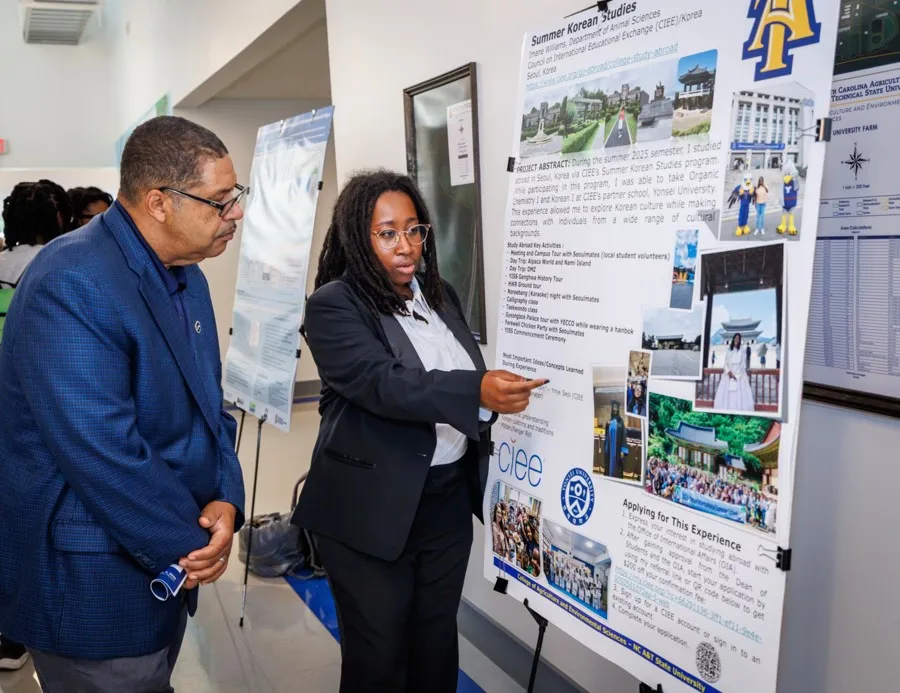
Students Present Summer Highlights in 2025 Showcase of Excellence

Students Present Summer Highlights in 2025 Showcase of Excellence

More than 100 College of Agriculture and Environmental Sciences students’ professional and academic summer experiences were on display at the 14th annual Student Showcase of Excellence, held Sept. 9 at the University Farm Pavilion.
Innovative Practices Lead to Small Farmer of the Year Award

Innovative Practices Lead to Small Farmer of the Year Award

At the age of 40, Mike Jones finally had enough resources to buy land in Franklin County and pursue his dream of owning his own farm. He came from a farming background, but the family lost its farm in the 1950s and since then, family members had worked as sharecroppers and tenant farmers. Fifteen years ago, he bought a 73-acre abandoned tobacco farm and turned it into a successful agricultural operation called MAE Farm. Today, he is the 2021 N.C. Small Farmer of the Year, a recognition awarded annually by Cooperative Extension at North Carolina A&T State University as part of Small Farms Week.
Happy New Year, CAES!

Happy New Year, CAES!

What a challenging year it has been! COVID recovery, product shortages and higher prices are just a few of the many challenges that growers, faculty and staff, students and our colleagues across the industry are facing this year. No wonder we are looking forward to the holidays and a new year!
CAES faculty will help lead new NIFA 1890 Center of Excellence for nutrition

CAES faculty will help lead new NIFA 1890 Center of Excellence for nutrition

CAES faculty will help to lead an 1890 Center of Excellence for Nutrition, Health, Wellness, and Quality of Life, a new, virtual center based at Southern University and funded by the U.S. Department of Agriculture’s National Institute of Food and Agriculture.
No results found.