“Not everyone in my class is going to go into agriculture, but if I can teach them how to be a better consumer and teach skills that, no matter what happens, they’d be able to feed themselves, then that’s what I’m meant to do.”
--Christopher Hicks
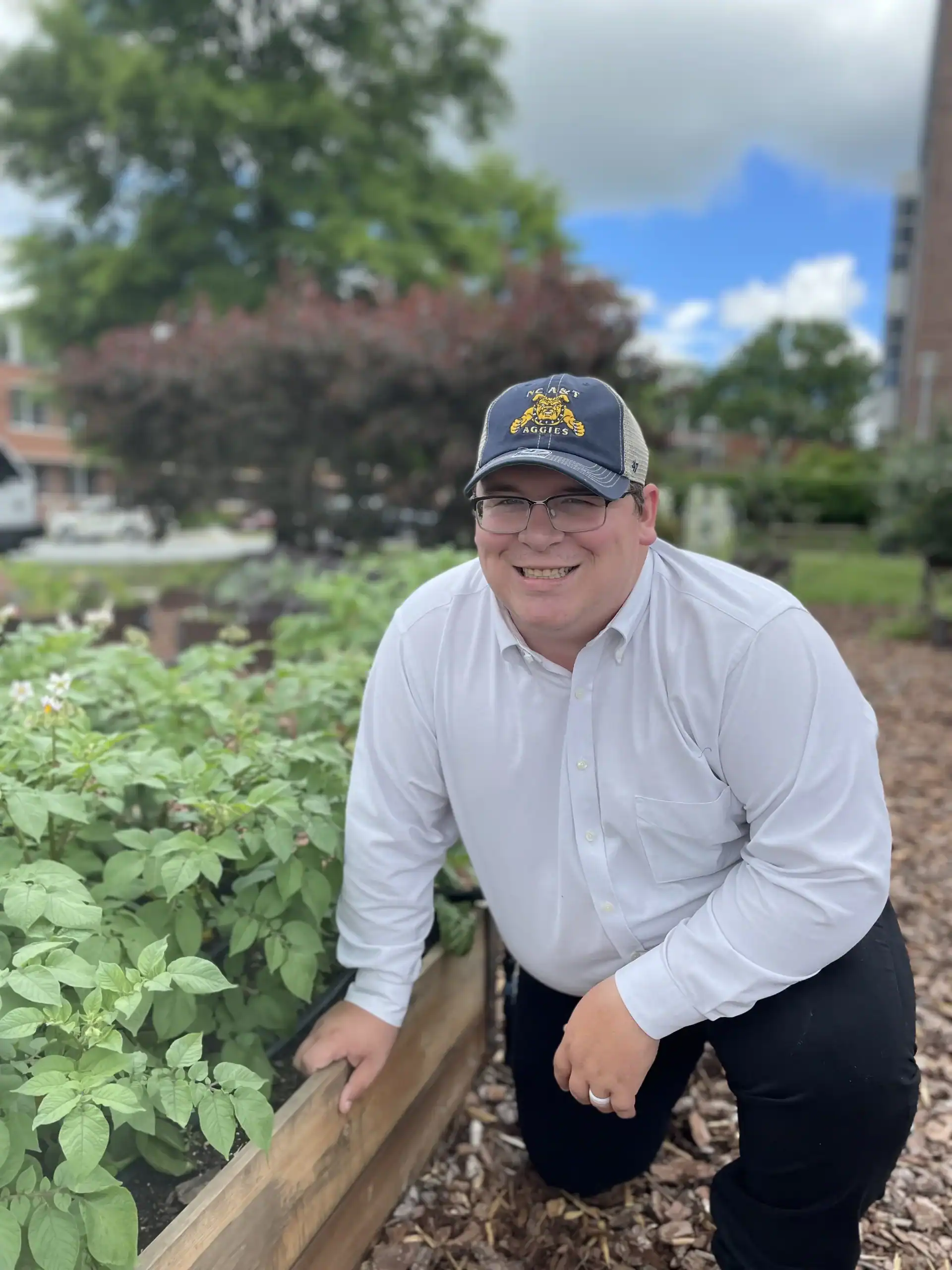
Christopher Hicks '22 spent his childhood learning about agriculture from his grandfather in Jones County. After earning his master's degree from N.C. A&T, he went back "down east" to teach the subject. Now, he is nominated for one of North Carolina’s top honors in career and technical education.
The Career and Technical Education (CTE) teacher at Eastern Wayne High School, is one of 24 finalists for the North Carolina Center for the Advancement of Teaching (NCCAT) 2027 Burroughs Wellcome Fund North Carolina Career and Technical Education Teacher of the Year Award.
“I’m excited to be a finalist, and I’ve known a lot of great ag teachers across the state who’ve not only been named a finalist but have also gone on to win the award,” said Hicks. “It’s an honor to be nominated in this pool of people I’d consider giants in CTE.”
As a finalist, Hicks will compete alongside 23 other educators from across the state. The finalists will participate in a week of professional development at NCCAT in Cullowhee in October. The statewide winner will be announced during a recognition event on Oct. 29 in Concord.
NCCAT, in partnership with the North Carolina Department of Public Instruction (NCDPI) and the North Carolina Association for Career and Technical Education (NCACTE), established the CTE Teacher of the Year Award to recognize outstanding educators, encourage teacher leadership, and highlight the critical role Career and Technical Education plays in North Carolina public schools.
According to Hicks, who is also a winner of Wayne County Public School’s CTE Teacher of the Year Award, says that he is the first candidate from Wayne County to be recognized as a finalist.
Hicks received his bachelor's degree in agricultural education in 2018 from the University of Mt. Olive. He came to A&T to earn his master’s in the College of Agriculture and Environmental Sciences.
“My grandfather was really big into agriculture when he was in school,” said Hicks. “That experience of working with him helped me want to pursue a degree and study it professionally.
“A&T had a great outreach program. Dr. [Antoine] Alston came (to Mt. Olive) every year with students to recruit for the college,” he said. “I always get along with people that are very personable and understand what it’s like to be connected and engaged with agriculture. Dr. Alston definitely had those qualities, and so I made the decision early on to enroll if I ever decided to pursue a master’s degree.”
Hicks credits the college's faculty with helping “offer support during bumps in the road.”
“Every time I needed support, the professors at A&T were really good about giving it,” said Hicks. “I still have strong relationships with Dr. Chastity English and Dr. Dana Wise. I talk to them at least once a month and collaborate when I do things in my classroom.”
“Chris is a wonderful colleague and ag educator in the field and a strong supporter of N.C. A&T and agricultural education across the state and the nation,” said English, professor and program coordinator for the college’s agricultural education program. “It has been a pleasure working with him and watching him grow.”
Since graduating from N.C. A&T, Hicks has held teaching positions across North Carolina in Trenton, Hampstead, Salemburg and Raleigh before his current role in Wayne County, where he teaches animal science, horticulture and agricultural mechanics, and serves as FFD Club advisor. Within his experience, he has committed to pushing agricultural education to potential growers on the large and small-scale.
“The real benefit of small-scale farming is you can grow food in your own back yard, and as a high school ag teacher, that’s what I’m trying to teach my students: Skills that they can use at home,” said Hicks. “Not everyone in my class is going to go into agriculture, but if I can teach them how to be a better consumer and teach skills that, no matter what happens, they’d be able to feed themselves, then that’s what I’m meant to do.”