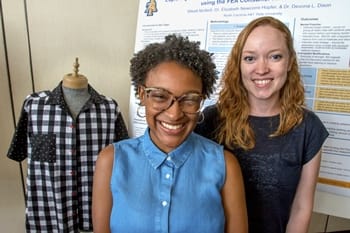
This summer, McNeill, a rising high school senior from Knightdale, tackled a design challenge of her own during the four-week Research Apprenticeship Program at A&T. Her father, who participated in the program 26 years ago, had encouraged her to apply.

Devona Dixon
Guided by faculty mentors Dr. Devona Dixon and Dr. Elizabeth Newcomb Hopfer in the Department of Family and Consumer Sciences, McNeill researched the clothing needs of individuals with physical disabilities, reviewed the clothing available and designed a fashion-forward shirt suitable for a man with cerebral palsy.
Early in her research, McNeill learned that the population of individuals with disabilities is huge. More than 56 million Americans are living with some type of physical or intellectual disability. In North Carolina, 13.9 percent of the population reports a disability that affects mobility, and 6.6 percent is unable to live independently.
McNeill then applied the FEA Consumer Needs Model (Lamb & Kallal, 1992), which stresses the balance of functional, expressive and aesthetic qualities. She determined that there is demand for practical and attractive clothing for individuals with disabilities, but a scarcity of supply.
“Much of the clothing sold to the disabled population is very out of date and never took into consideration the expressive and the aesthetic elements of the Consumer Needs Model, only the functional part of the model,” McNeill says.
She chose to focus on men’s apparel, because she wanted to address the needs of consumers with cerebral palsy, which is most commonly found in males. She decided to design an adaptive, fashionable men’s shirt. The project pushed her into uncharted territory as a designer. Before RAP, she only had experience creating clothing for herself and other women.
Doing more research, she identified key qualities for her shirt: soft, lightweight fabric and smooth seams for comfort, loose fit for range of motion, and a stylish mix of colors and prints. She chose to use cotton fabric for its softness, breathability, weight and ease of care. She selected black-and-white plaid and polka dot fabrics to create an attractive contrast. She opted for decorative red buttons to provide pops of color and magnetic closures for convenience.
The design made its public debut at the poster presentations during the RAP Closing Ceremony in July.
The project provided a learning experience for Newcomb Hopfer and Dixon as well as McNeill. Both faculty members will incorporate design for individuals with disabilities in new ways in their courses for A&T students. For example, Dixon plans to challenge students in her textiles course to consider persons with disabilities when evaluating fiber and fabric properties for specific apparel. In her course on the social and psychological aspects of dress, she will expose students to fashion consumers who may not be like them or who have special needs.
Her mentors were impressed with the research and with McNeill herself. “Mikaili came into the project with both interest and skill in fashion design and construction,” Newcomb Hopfer says. “I saw her grow throughout the project in both areas.”
McNeill says RAP was an experience she’ll treasure.
“Working in the department I want to major in was a once-in-a-lifetime opportunity,” McNeill says. “RAP not only gave me a little sliver of college life on A&T’s campus, but it allowed me to work toward my career goals and meet new people, some of whom I hope will be lifelong friends.”