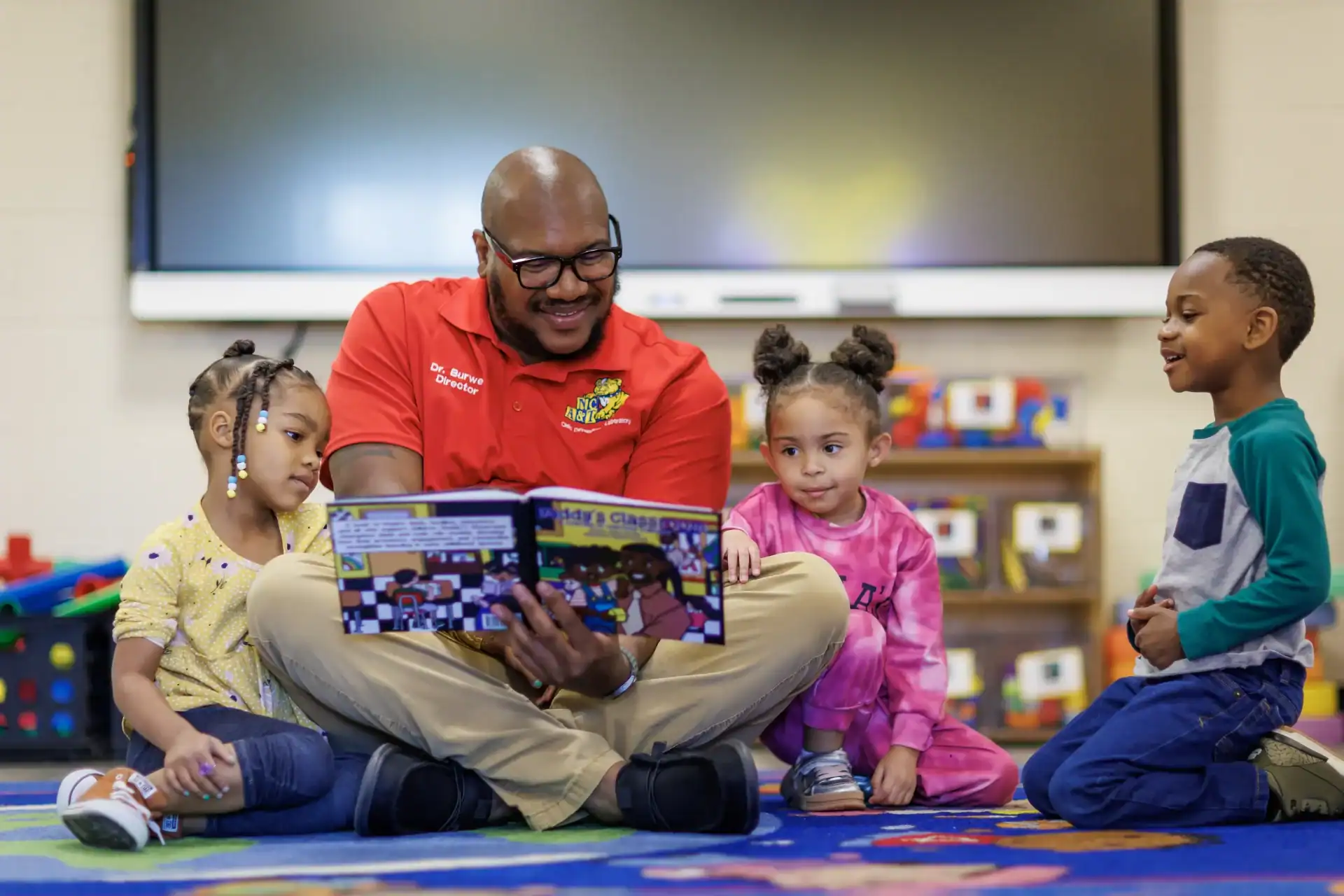
As director of the Child Development Lab in N.C. A&T’s Department of Family and Consumer Sciences, Jawan Burwell, Ed.D., has experienced many, many story times for kids.
What he hasn’t seen enough of is fathers telling those stories. Fathers and male caregivers are much less likely than mothers, grandmothers, and other women to be involved in their children’s preschool experiences.
Burwell is on a mission to change that and help fathers and father figures participate in their children's educational journeys.
“Society has painted this picture that fathers are the breadwinners; they provide for the household, and that’s it,” said Burwell. "But that limits what fathers can be and what children can experience."
Burwell has dedicated his career to creating a new vision for preschool, most recently, through two published books designed to challenge stereotypes and inspire action, with a particular emphasis on Black fathers and other fathers of color.
His children's book, "Daddy's Classroom: A Journey of Learning Together", tells a story rooted in his own childhood—the character Marquis is actually a young Burwell. The narrative follows a father, a character based on his own father, as he begins to engage in Marquis’ classroom, inspiring other fathers in the community to participate. Marquis’s teacher, Mr. Jordan, is based on Burwell’s brother, who is also an early childhood educator. Together, these characters reflect the meaningful influence that fathers, male caregivers, and male educators can have on young children and their communities.
Yes, It's a book for children, but also a powerful tool for adults to understand why father involvement matters.
“The book is also meant for adults – our fathers and also our teachers,” said Burwell. “Teachers must advocate and encourage fathers to let them know that it’s ok to come into a classroom and work with their children.”
His second book, "Engaging Fathers: Strategies for Inclusive Family Partnerships in Early Childhood," delves deeper, offering educators, administrators, higher education faculty, family engagement specialists, social service professionals and community leaders concrete strategies for creating father-friendly cultures in their programs. Through personal stories and research-based recommendations, Burwell addresses the real barriers that keep fathers on the sidelines: work schedules, social stigma, lack of male role models in early-childhood education, and unintentional intimidation in unfamiliar environments.
The books have made Burwell a star in some circles; "Daddy’s Classroom" is a #1 Amazon bestseller in the childcare category. "Engaging Fathers" has garnered attention among educators for its practical advice.
Burwell's approach recognizes that not all families look the same. In addition to making sure his message reaches Black and brown families, he advocates for inclusive language—using terms like "family," "parents," and "caregivers" instead of defaulting to "mom and dad."
“Rather than saying “mom and dad, we can use inclusive language, such as family or parents and caregivers, or special adults,” he said. “That way no child feels excluded when their family structure doesn't look like the typical mom and dad.”
He makes it clear that classroom teachers and administrators must work to welcome fathers in what are often unfamiliar environments. Educators, accustomed to communicating primarily with mothers are sometimes unsure how to include them meaningfully. Workplace cultures rarely accommodate dads’ involvement in their children’s lives. Lower-income fathers face even greater obstacles to participation, such as working more than one job or lacking transportation.
The landscape is complex, but Burwell’s message remains consistent: fathers want to be involved in their young children’s education; they simply need the opportunity, the invitation, and the assurance that they belong.