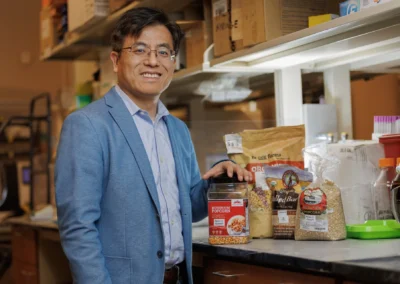
N.C. Department of Agriculture and Consumer Services Commissioner Steve Troxler shared the agency's goals for increasing the state's agricultural resilience in the face of the pandemic and policy changes in a recent forum.
U.S. agriculture faces serious challenges from climate change, trade issues and the pandemic, but we can stay ahead of these issues by adopting a forward focus, N.C. Commissioner of Agriculture Steve Troxler told his audience of students and faculty in a recent virtual forum with the CAES.
The forum is the third involving the N.C. Department of Agriculture and Consumer Services and the college to discuss issues in agriculture.
“As a farmer, you have to be an eternal optimist and believe this year will be the best ever,” Troxler said. “We know that this year will be a challenge based on the pandemic, trade issues and other factors, but we can have a good year if we keep our focus on agricultural policy.”
Success in agriculture is most commonly associated with weather, and although weather events such as recent hurricanes can affect N.C. agriculture profoundly, policy issues are at least as important, Troxler said.
“Policy determines what’s sold, where, when it’s sold and what its price will be,” Troxler said. “Right now, the populations of large cities control the legislature, full of people who don’t necessarily notice agriculture until something like the pandemic happens and grocery store shelves don’t have the quantity or variety that they’re used to.
“It will be our big task in the future to educate the public, who have no idea of what we do.”
Research will also play an important role, and those in agriculture will need to advocate for increased funding for research, he said.
“Studies show that we get a $19 return on every $1 research investment,” said Troxler. “That seems like an easy sell, but not as long as the grocery store shelves are stocked. Then, it’s an issue for tomorrow. We have to continue to make research funding an issue for today. We have to be prepared for the future, even if we don’t exactly know what the future might be.”
The increasingly technological nature of agriculture has also decreased the number of people to lobby for policy, Troxler said, as a consequence of efficiency, there are fewer farmers.
Along with policy and technology, weather does play a pivotal role in agriculture, both locally and around the globe, he said. Climate change and sea-level rise will be part of the state’s long-term discussions as the state strives to boost its resiliency.
“North Carolina has experienced so many disasters that there’s not a lot of resilience to be had,” he said. “Near-back-to-back hurricanes really impacted us. We need to look at where water flows, how to handle storm water, as more buildings and roadways take up what used to be farmland.”
Luckily, the state legislature is responsive, acting quickly to fund a $240 million program for farmers and agriculture.
Environmental issues also bring opportunity, Troxler said.
Troxler said he supports planting more trees for carbon sequestration, a process in which carbon dioxide is removed from the atmosphere and held in solid or liquid form, and used to slow or reverse carbon dioxide pollution and help to reverse global warming.
Other positives for the state include international trade agreements with Mexico, Canada and China, and strong growth in other markets, including the European Union and United Kingdom. The demand for beef, poultry and pork worldwide is also robust, he said.
North Carolina has increased its slaughtering capacity in the wake of the pandemic with $15 million targeted for traditional facilities and $5 million for fish and shrimp produced in North Carolina. Another $12 million has gone to food banks, and $750,000 to the state’s Farmers Markets.
Hemp production, however, has proved tricky. Originally touted as a replacement for tobacco as a commodity crop, legal issues about THC levels have made it controversial, Troxler said.
“We’re going to have to come up with a voluntary regulatory structure for hemp production,” Troxler said. “It has been difficult and controversial. Instead of a state program, we may have a federal program and let them certify the crop’s viability.”