CaesNews

Where Science Meets Society

CaesNews

Where Science Meets Society

Sang awarded two grants to study foods’ effects on the body, disease prevention

February 16, 2021

|

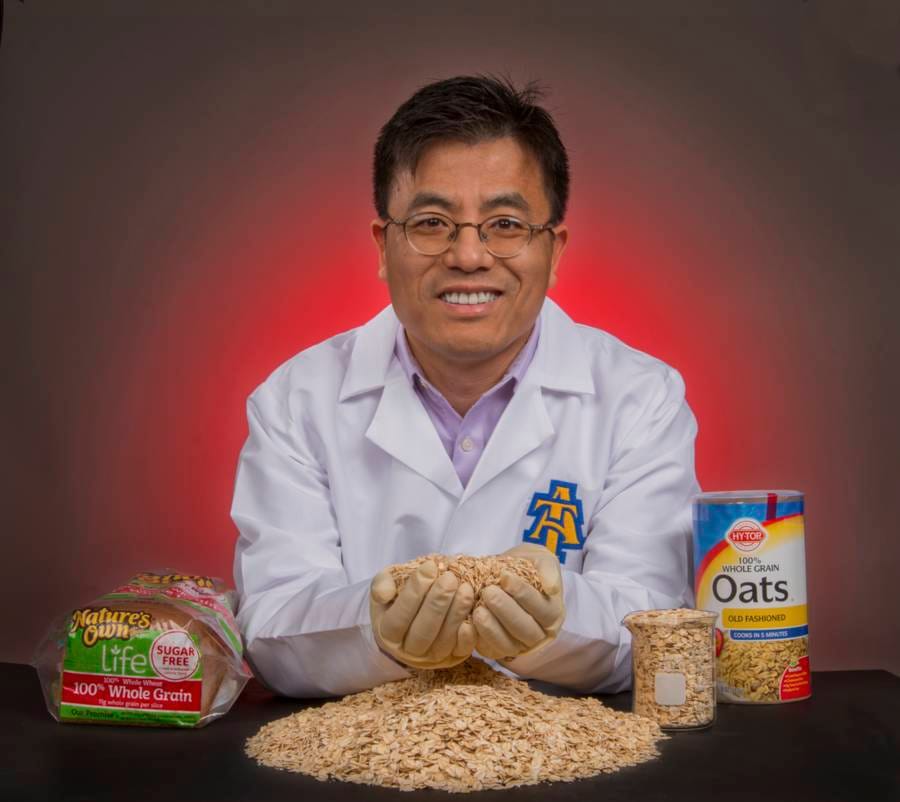
Organic whole grain oats with a scientist demonstrating the health benefits and nutritional value of.

Shengmin Sang, Ph.D. will use his grant funds to study oat products' ability to prevent and combat chronic inflammatory diseases and the healthy compounds in apples.

Shengmin Sang, Ph.D., a professor of functional foods and human health at N.C. A&T’s Center of Excellence for Post-Harvest Technologies at the North Carolina Research Campus in Kannapolis, has been awarded two grants totaling nearly $1 million from the USDA’s National Institute of Food and Agriculture.

Each grant will examine the effects of a type of food on disease prevention in humans, potentially offering significant new dietary options for preventing and treating disease.

The grants are awarded through USDA NIFA’s Agriculture and Food Research Initiative, a highly competitive research program.

“Increasing evidence shows that many chronic diseases are preventable, and diet plays a very important role in disease prevention and treatment,” Sang said. “The general public prefers dietary regimens, instead of drugs, for preventing or treating chronic diseases.”

The first, three-year grant of $499,000 will be used to develop novel functional oat products for consumers using germination and false-germination approaches. Preliminary data has shown that oat products can prevent and combat chronic inflammatory diseases, such as inflammatory bowel disease and the colorectal cancer often associated with IBD, Sang said. Oats that have germinated, or begun to grow, have significantly more of the phytochemicals – plant-based chemicals that protect cells – that can boost oats’ anti-inflammatory properties.

The second, three-year grant of $499,975 will study the effects of the healthy compounds, or polyphenols, in apples on reactive carbonyl species (RCS) in humans. Some research shows that RCS can play a critical role in the development of many chronic diseases, such as diabetes and diabetic complications, Alzheimer’s disease, and cardiovascular disease. Studies in mice from Sang’s lab have shown that polyphenols from apples and other foods can efficiently trap RCS and prevent them from damaging proteins and lipids to generate the advanced glycation end products (AGEs). AGEs play a role in the development of diabetes and diabetic complications and age-related illnesses, including atherosclerosis and chronic inflammatory diseases.

“It’s still largely unknown whether this happens in humans,” Sang said. “The goal of this study is to determine the effects of apple polyphenols on trapping RCS when eaten, and determine if they prevent AGEs accumulation in humans.”

Read more CAES News

Wayne County Teacher Finalist for Statewide Teaching Award

Wayne County Teacher Finalist for Statewide Teaching Award

Christopher Hicks '22 spent his childhood learning about agriculture from his grandfather in Jones County. After earning his master's degree from N.C. A&T, he went back "down east" to teach the subject. Now, he is nominated for one of North Carolina’s top honors in career and technical education.
Lay of the land: Walter Hood ’81 digs deep into spaces’ history to revitalize their present

Lay of the land: Walter Hood ’81 digs deep into spaces’ history to revitalize their present

Mention “landscape architecture” in conversation, and the thoughts of many will turn to bright green lawns edged by manicured, blooming bushes and trees. But landscape architecture is more than “landscaping,” the maintenance of a space. It’s about its design and function, a mix of natural and built features that achieve a certain purpose.
Back in the Saddle

Back in the Saddle

Tracy Hanner, D.V.M., a 32-year veteran of the College of Agriculture and Environmental Sciences, has returned to campus this year to guide the Department of Animal Sciences as interim chairperson.
“Dr. Yang’s Kids” — Now “Doctors” Themselves— Grow Up to Educate, Mentor Others

“Dr. Yang’s Kids” — Now “Doctors” Themselves— Grow Up to Educate, Mentor Others

Three first-year students walked into NARS 110 class one day in 2013 and got far more than a lesson in urban and community horticulture. They found a friendship that has sustained them, personally and professionally, throughout their undergraduate years in the College of Agriculture and Environmental Sciences; through their graduate school years, some in other states; to this day, in which all three can call themselves “Dr.”
No results found.

Never Miss an Issue


By submitting this form you agree to receive emails from the College of Agriculture and Environment Sciences at North Carolina Agricultural and Technical State University. You can unsubscribe at any time.

Recent Articles

N.C.  A&T Names Goins Dean of the College of Agriculture and Environmental Sciences

Research Apprenticeship Program Wraps Up Summer at N.C. A&T

Cooperative Extension at N.C. A&T Awards Three Team Members