CaesNews

Where Science Meets Society

CaesNews

Where Science Meets Society

HomeLearn More

Sign up for the Newsletter

Sang awarded two grants to study foods’ effects on the body, disease prevention

February 16, 2021

|

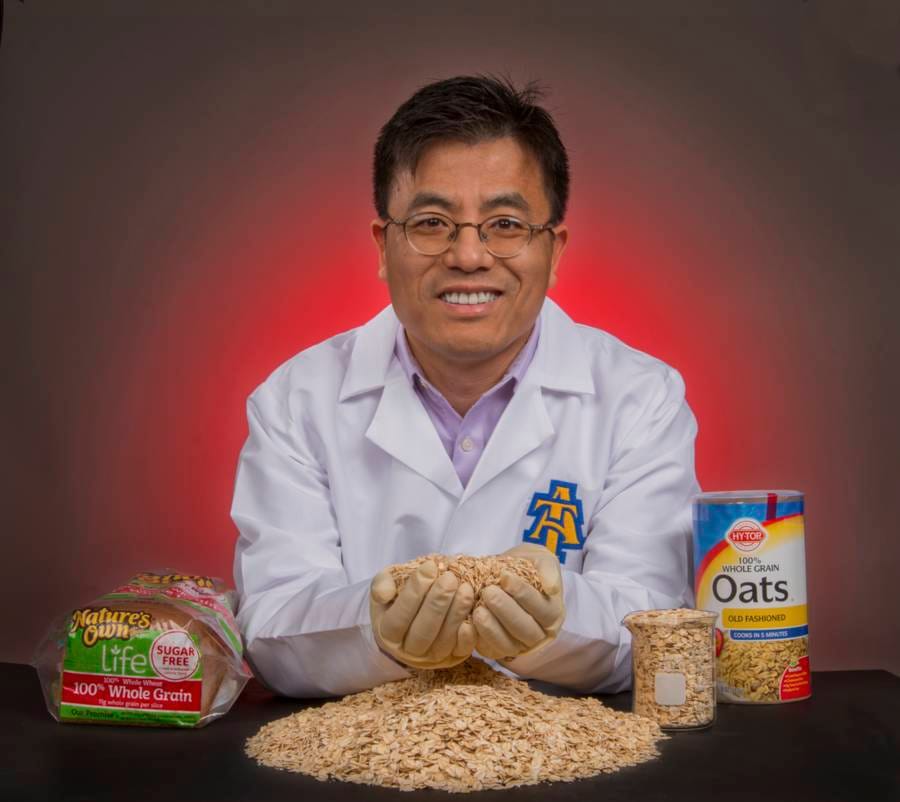
Organic whole grain oats with a scientist demonstrating the health benefits and nutritional value of.

Shengmin Sang, Ph.D. will use his grant funds to study oat products' ability to prevent and combat chronic inflammatory diseases and the healthy compounds in apples.

Shengmin Sang, Ph.D., a professor of functional foods and human health at N.C. A&T’s Center of Excellence for Post-Harvest Technologies at the North Carolina Research Campus in Kannapolis, has been awarded two grants totaling nearly $1 million from the USDA’s National Institute of Food and Agriculture.

Each grant will examine the effects of a type of food on disease prevention in humans, potentially offering significant new dietary options for preventing and treating disease.

The grants are awarded through USDA NIFA’s Agriculture and Food Research Initiative, a highly competitive research program.

“Increasing evidence shows that many chronic diseases are preventable, and diet plays a very important role in disease prevention and treatment,” Sang said. “The general public prefers dietary regimens, instead of drugs, for preventing or treating chronic diseases.”

The first, three-year grant of $499,000 will be used to develop novel functional oat products for consumers using germination and false-germination approaches. Preliminary data has shown that oat products can prevent and combat chronic inflammatory diseases, such as inflammatory bowel disease and the colorectal cancer often associated with IBD, Sang said. Oats that have germinated, or begun to grow, have significantly more of the phytochemicals – plant-based chemicals that protect cells – that can boost oats’ anti-inflammatory properties.

The second, three-year grant of $499,975 will study the effects of the healthy compounds, or polyphenols, in apples on reactive carbonyl species (RCS) in humans. Some research shows that RCS can play a critical role in the development of many chronic diseases, such as diabetes and diabetic complications, Alzheimer’s disease, and cardiovascular disease. Studies in mice from Sang’s lab have shown that polyphenols from apples and other foods can efficiently trap RCS and prevent them from damaging proteins and lipids to generate the advanced glycation end products (AGEs). AGEs play a role in the development of diabetes and diabetic complications and age-related illnesses, including atherosclerosis and chronic inflammatory diseases.

“It’s still largely unknown whether this happens in humans,” Sang said. “The goal of this study is to determine the effects of apple polyphenols on trapping RCS when eaten, and determine if they prevent AGEs accumulation in humans.”


Read more CAES News

DIXON MAKES INTERNATIONAL SPLASH

DIXON MAKES INTERNATIONAL SPLASH

Dr. Devona Dixon, an assistant professor in the Department of Family and Consumer Sciences, is enriching her spring-semester classroom instruction with insight from her winter sabbatical focused on textile production. Dixon spent two weeks in Yucatan, Mexico on a textile and tourism study-tour for professionals hosted by the International Textiles and Apparel Association of which she is a member.
SAS AI Platform to Help N.C. A&T, NCSU Take Research to the People

SAS AI Platform to Help N.C. A&T, NCSU Take Research to the People

North Carolina Agricultural and Technical State University will partner with North Carolina State University and data and AI (artificial intelligence) provider SAS to create a unique, cloud-based platform to advance agricultural research at the two land-grant universities, and tailor the platform to make those results easier to deliver across the state.
Levon Esters M.S. ’00: Pursuing excellence at Purdue

Levon Esters M.S. ’00: Pursuing excellence at Purdue

Levon Esters, Ph.D.Levon Esters, Ph.D., who earned his master’s in agricultural education at A&T in 2000, was ...
Food science professor starts endowment to take bite out of funding challenges

Food science professor starts endowment to take bite out of funding challenges

Salam A. Ibrahim, Ph.D., is passionate about food science. In his 21 years as a professor in the Department of Family and Consumer Sciences, Ibrahim’s contributions have ranged from ground-breaking research to improve the quality, shelf-life and safety of dairy food products, to helping the food industry solve problems related to packaging and transportation.
No results found.

Never Miss an Issue


By submitting this form you agree to receive emails from the College of Agriculture and Environment Sciences at North Carolina Agricultural and Technical State University. You can unsubscribe at any time.

Recent Articles

Conference Addresses Rural Roots, Connected Communities in Fast-Growing North Carolina

A&T Extension’s Smith Inducted into the 2025 N.C. 4-H Hall of Fame

Farmers Hit the Road to Learn From Western N.C. Peers