Rhonda Watlington had every intention of starting a small garden three years ago when she bought a raised gardening bed, but …
“It’s still in the box … it’s still in the garage,” she said, admitting to being a bit intimidated by starting a garden when she has no experience.

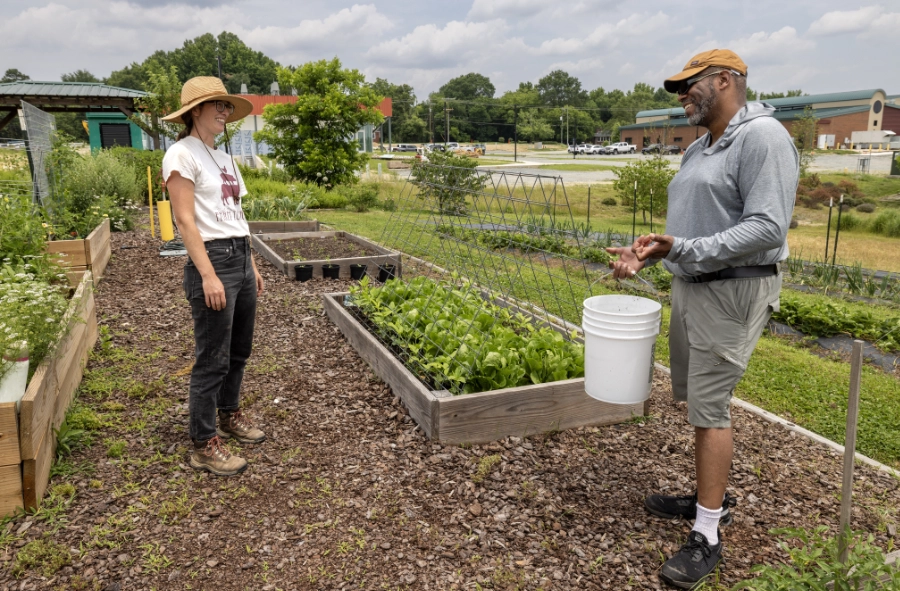
Rhonda Watlington, left, chats with Malone during an event at the University Farm’s community garden.
However, through a joint venture of Cooperative Extension at N.C. A&T and the College of Agriculture and Environmental Sciences at N.C. A&T State University, Watlington is finding the resources and the incentive she needs to dig that box out of the garage and start growing.
Extension and the college run the Student and Community Farm at the University Farm on McConnell Road. And while there a few rental spaces set aside for gardening, “the community garden is really meant to be an outreach opportunity for people to learn more about community gardening and how they can get involved in their area,” said Morgan Malone, urban agriculture and community gardens coordinator for Extension.
There’s also a high tunnel structure available, allowing community gardeners to get a jumpstart on the growing season.
“My role is to support community gardens and urban ag projects across the state, primarily in our urban areas, but also in our rural areas,” Malone said, “to make sure they get the support and resources they need to be successful over the long run.”
North Carolinians interested in joining a community garden can email Malone at mlmalone@ncat.edu to find out what gardens are available near them. The Extension offers help with starting a community garden, facilitating an interest meeting and developing a financial plan.
The program also offers a Community Garden Leadership Academy at locations around the state, Malone said, “to teach people the foundational skills of leadership and community garden management.”

Will Ragin, a regular volunteer, works in the University Farm’s community garden.
University Farm community garden volunteer Will Ragin, a Guilford County master gardener, said community gardens are extremely important to fight food insecurity and to improve the health of residents by allowing them to reconnect with nature.
“A lot of people are intimidated by gardening,” Ragin said. “They also think it takes a tremendous amount of time.” But community gardens allow them to “take baby steps,” he said.
Watlington looks forward to working with Malone to get her own garden established. “I’m one of those learners who wants to see somebody who is successful — and/or not — and talk to specialists,” she said. “I have a lot of questions in reference to getting started.”
Watlington anticipates the garden will save her money at the grocery store, as well as encouraging her to eat a healthy diet and feel good about cooking what she’s grown. She plans to start out with herbs and work her way up to other vegetables, such as tomatoes.
“I'm gonna walk outside on my patio and to my raised bed and get a few mint leaves and some cilantro. That makes me feel like I'm really engaged in cooking, and I know … the product that I'm growing,” Watlington said.