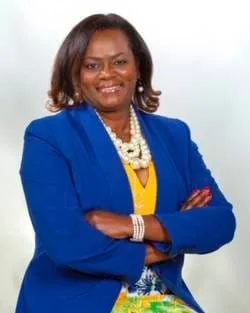
Rosalind Dale, Ed.D.
“I didn’t set out to be an administrator at all,” said Dale, Ed.D. who holds a doctorate in adult and continuing education. “But it became clear to me through my work and education that management and leadership was the direction in which I wanted to move.” Dale already had a home economics degree when she decided to pursue a second degree in human services administration followed by her doctorate, hoping to use her new skills as an organizational leader.
She began her Extension career in the Family Nutrition Program (FNP) with University of Illinois Extension in Chicago. She soon moved to the Expanded Food and Nutrition Education Program (EFNEP), supervising staff and making community connections in some of the most distressed neighborhoods in the city. EFNEP made her realize that Extension work was her future; sharing her expertise in a way that helped people in need would become a calling as much as a job.
By the time she left Illinois for North Carolina in 2011, administration had already become part of that calling. As district coordinator for Cook County Extension (the county dominated by the city of Chicago) she oversaw the programming, staff and budgets for offices in Chicago.
“When I first finished my doctorate, I sat down with Dr. Oliver (James D. Oliver, then a regional administrator with Extension in Illinois) and he asked me, ‘What are you going to do now?’” Dale recalled. “At the time I hadn’t thought much about making a change, but a year later, I was back in his office talking about doing something different.”
That something different involved a move to North Carolina and a new position with Cooperative Extension at N.C. A&T as regional program coordinator for the central region of the state. That was in 2011. By 2015, she had stepped into the role of administrator for Extension at A&T, a job that involves leading a staff of more than 110 professionals and ensuring that Extension at A&T programming addresses the needs of limited-resource North Carolinians in 100 counties and the Eastern Band of Cherokee Indians. She was the first female Extension administrator at A&T.
“My perspective is different for a number of reasons,” said Dale. “First, I had been at another land-grant institution for 17 years and that helped me look at things a little differently and forced me to learn how things work here from the ground up.”
Additionally, she acknowledged that being a woman in the administrator role brings challenges. Most of her administrative colleagues around the nation are male, white, and have a background in agriculture specialties rather than in family and consumer sciences.
“It would be easier to be a female administrator if my background fit more squarely into agriculture,” she said. “But being an agriculture expert is not the main skill you need for this job. We have an excellent team of diverse subject matter specialists for that.”
Dale sees her job as making sure Extension at A&T has the staff and the resources to transfer knowledge to farmers, families and youth, with a special emphasis on those in underserved and minority communities. To do that successfully means wrangling money and other resources to support and sustain programs, she added. She must stay current on USDA and NIFA policies, keep an eye out for grant opportunities, and work to achieve funding equity for 1890 institutions.
“One of the first things I saw here was that we didn’t have a full state match,” she said. “I’ve worked with the university and college leadership on that because you need to make sure the resources are there to develop programs and expand outreach efforts.”
In addition to working to secure equitable funding, Dale said she is proud of increasing Extension staff at A&T, developing a strategic plan that closely matches programs to an organizational vision and goals, and bringing SNAP-Ed to A&T, a nutrition education program aimed at those eligible for the Supplemental Nutrition Assistance Program (SNAP).
Although being a female administrator in a male-dominated role can mean coping with stereotypes and having to navigate different communication styles and traditions, Dale said knowledge and a record of success helps. It also helps to have someone you can talk to.
“You need a mentor; someone you can relate to, a self-ethnic reflector,” she said. “I don’t take it lightly to be in this position and what it means for young black women to see someone who looks like them in a position of authority. You need some folks to talk to who have experienced the same things.”