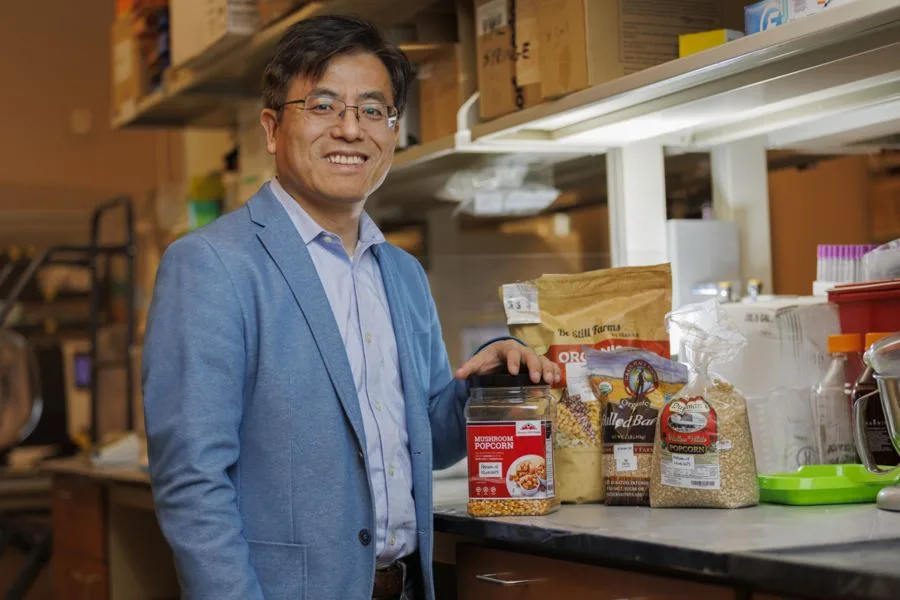
North Carolina Agricultural and Technical State University has named Mohamed Ahmedna, Ph.D., a renowned researcher and an N.C. A&T faculty member between 2000 and 2010, dean of the College of Agriculture and Environmental Sciences, effective Oct. 1.
Ahmedna has been a fellow with the American Association for the Advancement of Science at USDA’s National Institute of Food and Agriculture in Washington. He also was a professor of food science and nutrition at Qatar University, where he served as associate dean for research and graduate studies in the College of Arts and Sciences, 2010-2016.
“Our College of Agriculture and Environmental Sciences has a rich history of innovation, practical research and delivery of educational programs for students and North Carolina communities,” said Provost and Executive Vice Chancellor Beryl McEwen. “I’m delighted with Dr. Ahmedna’s return to a college where he accomplished so much as a faculty member and researcher, and look forward to the leadership and vision he will bring to his new role as dean.”
During his previous time at A&T, he served as founding director of the university’s Center for Excellence in Post-Harvest Technologies, part of the North Carolina Research Campus in Kannapolis, 2006-2010. Prior to that post, he moved through the faculty ranks as an assistant, associate and full professor in the Food Science and Nutrition Program in the Department of Family and Consumer Sciences.
As principal investigator or co-principal investigator, Ahmedna has received $26 million in competitive research grants and authored more than 200 publications and presentations over the course of his career. His research focuses on value-added product development with an emphasis on functional foods and bioactive compounds, as well as lifestyle interventions for health promotion and chronic disease prevention.
He earned a patent for a process to reduce allergens in peanuts and filed three other patent applications. His research has been covered by major national and international media outlets.
His research awards include the Thurgood Marshall Fund’s Distinguished Faculty Member Award, A&T’s Outstanding Senior Researcher Award and the United States Agency for International Development’s George Washington Carver Agricultural Excellence Award.
He has taught undergraduate and graduate courses in research methods, as well as graduate courses in sensory evaluation, food preservation and food product development. He has served as the primary advisor for 16 master’s students and two Ph.D. students.
Ahmedna holds a bachelor’s degree in fisheries and ocean engineering from the Institut Agronomique et Veterinaire Hassan II. He has earned three master’s degrees: one in food science from Louisiana State University (LSU), one in applied statistics from LSU and one in business administration from the University of North Carolina at Chapel Hill. He received his doctorate in food science from LSU.
“I’m thrilled to have the opportunity to give back to an institution that enabled me to excel as a scientist and become who I am today,” Ahmedna said. “I’m excited by the unlimited potential for growth of the college, given our talented faculty, staff and students, the bold vision of the university’s leadership and the strength of N.C. A&T’s legacy.”