

Zanethia Barnett, Ph.D
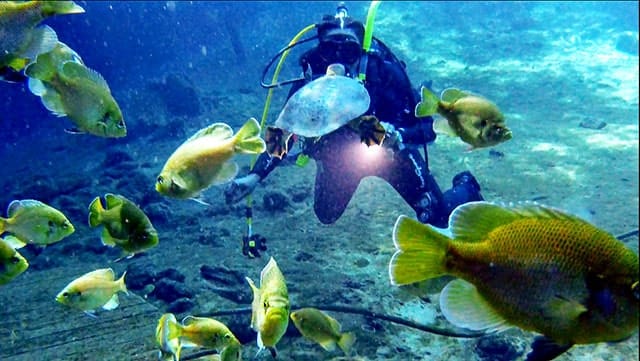
A freshwater stream full of crayfish may make some think of a tasty meal. To Zanethia Barnett, Ph.D., a research fisheries biologist with the USDA’s Forest Service, it means a healthy ecosystem. An important food source for larger fish, crayfish can be indicators of good water quality and biodiversity.
Barnett, a 2010 graduate of the Department of Agribusiness, Applied Economics and Agriscience Education, knows that her work also has a big role to play in the overall health of freshwater ecosystems. As a natural resource specialist at the Center for Bottomland Hardwoods Research in Oxford, Mississippi, she investigates the way environmental factors, including human management, impact freshwater aquatic ecosystems’ biodiversity.
“It’s important to understand the relationships between species and their environment,” she said. “My research focuses on understanding the relationship among fish, crayfish and their environment, as well as how disturbances, both natural and anthropogenic, impact these relationships.”
Building a dam in a stream, for example, may mean a steady water supply for the towns and cities nearby. But for the organisms in the stream, however, it may mean extinction.
 “I look at the costs of environmentalism,” she said. “For example, if a city builds a dam so that it can have a steady water supply, it may mean that only a small part of the biodiversity is maintained. There may be 25 species in a stream, but only the five most dominant might survive the dam building. At the same time, the dam is important for the people who count on it for water. I look at how to manage the dam to keep the stream healthy, while at the same time helping the city, which is economically impacted by the way the dam’s managed.”
The ability to consider the economics of agricultural problems is a skill Barnett credits N.C. A&T with teaching her during her undergraduate years as an agricultural economics major.
Growing up in Estill, South Carolina, Barnett spent time on the water, fishing and hunting with her father. Her grandfather was a farmer, but she hadn’t thought about agriculture as a career until a representative of the USDA 1890s Scholar program visited her high school.
“I had done well in economics in high school, and was considering being a lawyer,” she said. “The representative said that I could major in agricultural economics and get the benefit of the scholarship, and still go to law school.
“Once I got to A&T, I discovered that it was the agriculture classes that I took along with the economics classes that I loved. So I began taking extra classes to set myself up for grad school.”
She joined the FFA and Minorities in Agriculture, Natural Resources and Related Sciences chapters, and through her experiences at MANRRS conferences learned that research activities were being carried on by diverse students and scientists.
“That was really eye-opening, because I realized that the people conducting this research were not that different from me,” she said. “The network and connections I made helped me realize the potential of my degree.”
Barnett earned a master’s in interdisciplinary ecology from the University of Florida, where she was a Forest Service Chief Scholar Fellow, and her Ph.D. in biology from the University of Mississippi.
“I had grown up in a small, rural town, and going to college in another state was very, very scary,” she said. “I had never visited campus, never even heard of it. I was my high school’s salutatorian, but I thought I’d be the first salutatorian to ever flunk out of college.
“After I got to campus, I met other freshmen in the Honors College and realized our fears were all the same. I connected with upperclassmen at AggieFest my freshman year, and met friends that gave me the confidence and the support that I needed.”
Talks with her mentor, Kenrett Jefferson-Moore, Ph.D., chairperson of the AAEAE department, also instilled confidence that went beyond classroom work, Barnett said.
“She was really open, and cared about more than just our schoolwork,” Barnett said. “You could talk to her about relationships, personal things, or if you were just feeling inadequate. She was a big motivator for me.”
That boost of confidence has carried her not just to a doctorate degree, but through situations in which she was the youngest team member or unique for her race.
She cherishes the years she spent at A&T and the connections she made with people who went on to successful careers. She got to know people who went to work for NASA, earned Ph.D.s, and become veterinarians and doctors. Her experience was beyond her wildest dreams as a high school student.
“A&T was honestly the best time in my life,” Barnett said.
Read more about Zanethia Barnett, Ph.D., in a profile written by the Forest Service for its Women in Science series: https://www.srs.fs.usda.gov/women-in-science/zanethia-barnett/.


