CaesNews

Where Science Meets Society

Logo featuring the letters "A" and "T" in blue and gold, representing North Carolina Agricultural and Technical State University.

CaesNews

Where Science Meets Society

Home

Sign up for the Newsletter

CAES Senior’s Initiative Wins Grant for Med School Tour 

|

A group of 17 young African American men pose outdoors in front of a modern building with large glass windows and a white facade. They are dressed in formal business attire, wearing suits in shades of navy, black, and gray, paired with dress shirts and ties. Some of them have name tags pinned to their jackets. The group stands on a paved courtyard with greenery and a tree nearby, smiling confidently at the camera.

N.C. Agricultural and Technical State University students who participated in the Men’s Roundtable in Biology professional development trip to Nashville, Tenn., this fall included (from left) Demetrius Booker, Micah Downs, Eric (Dré) Ford, Jordan Speller, Justin Fraser, George Babineaux, Donovan Garner, Charles-Anthony Woodfork, Dristen Lakes, Nigel Belcher, Brandon Artis, Khalil McKoy, Aaron McBride, Khari Harriday and Jordan Cohen.

Make those connections. That’s the advice Charles-Anthony Woodfork, a senior American Heart Association HBCU scholar who is studying food and nutritional science, gives to his fellow Aggie students.

Woodfork is also president and co-founder of the student organization Men’s Roundtable in Biology (M.R. Biology), and he speaks from experience. Through his connections, Woodfork was able to make a tour of medical schools for M.R. Biology members into reality recently.

He discussed with Jordan Cohen, M.S., an instructor in the College of Science and Technology, and drew from his contacts at the association, where he also worked as an intern for its health equity team last summer.

“I knew the AHA provided grants and they were very big on student success, but I didn’t know if they would do it,” he said. Despite his uncertainty, Woodfork approached Pamela Gorman Johnson, a senior vice president with whom he had worked, to see if she knew of any organizations that would give grants to student organizations.

“Well, how much do you need?” she asked him. After giving her a rough estimate, Gorman Johnson told Woodfork to come up with a potential budget and itinerary. Ultimately, Garmon Johnson joined Woodfork in pitching the idea to the rest of the AHA health equity team, which then approved the $8,5000 grant.

Woodfork also reached out to another AHA contact, Joey Barnett, Ph.D., professor emeritus at Vanderbilt University School of Medicine. Barnett put him in touch with four cardiovascular medicine fellows at Vanderbilt Medical Center, who facilitated a tour there for the group.

Meanwhile, Cohen contacted Meharry Medical College, one the oldest and largest historically Black medical schools, where he was an alumnus. This resulted in an invitation to tour the college and Meharry Hospital.

The group — thirteen students and two advisors — traveled to Nashville, Tenn., from Oct. 31 to Nov. 2, to take the tours and speak with several doctors about their journey in the medical field. The group also explored Nashville, including the National Museum of African American Music.

The experience reinforced life lessons that Woodfork, an honors student and Dowdy scholar, said he’s learned at N.C. A&T.

“One of the biggest phrases I’ve learned since I’ve been at A&T is: ‘Your network is your net worth,’ ” Woodfork said.

“Of course, it’s important to be technically proficient, to know what you're doing and to be good at what you do,” he said. “But in that same vein, it’s very important to be connected to people, places and organizations that can support you and that can help you.”

Other students and faculty who took part in the trip include: Donovan Garner, George Babineaux, Aaron McBride, Khalil McKoy and Micah Downs, all senior biology students; Brandon Artis, Dristen Lakes, Nigel Belcher and Jordan Speller, all junior biology students; Eric (Dre) Ford and Justin Fraser, sophomore biology students; Khari Harriday, junior kinesiology student; and advisers Cohen and Demetrius Booker, M.S., biology instructor.
Would you like to learn more about N.C. A&T State University?

Founded in 1891 in Greensboro, North Carolina, N.C. A&T is the nation’s largest historically Black university and a premier 1890 land-grant doctoral research institution. Home to more than 14,000 students, A&T is nationally recognized as the top public HBCU in the country and the number one producer of Black graduates in engineering and agriculture. With over $2.4 billion in annual economic impact, the university combines rigorous academics, pioneering research, and a vibrant campus culture to prepare the next generation of global leaders. 

Read more CAES News

Research Apprentice Program Gives High School Students ‘a Little Bit of Everything’

Research Apprentice Program Gives High School Students ‘a Little Bit of Everything’

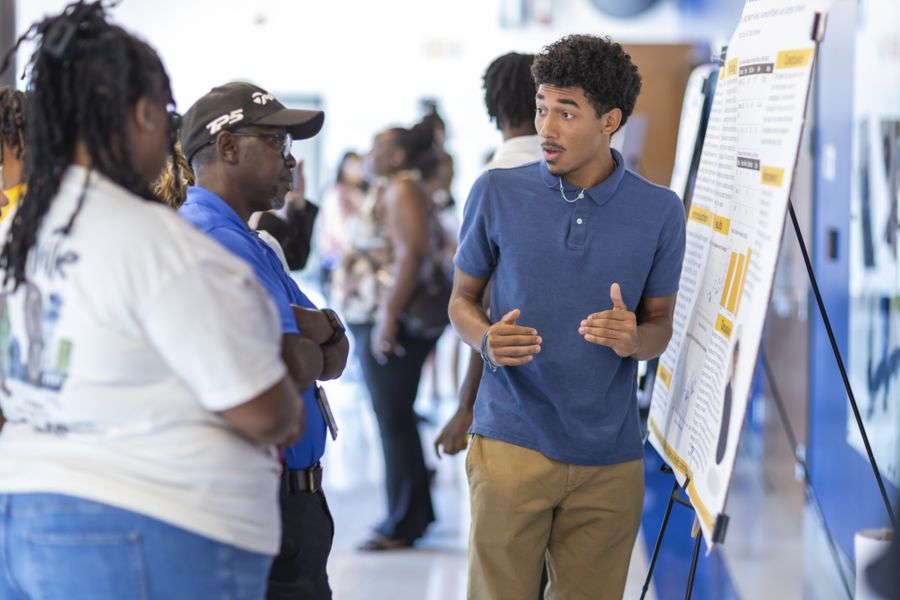
Lillie Ray’s poster presentation at the 2025 Research Apprentice Program at North Carolina Agricultural and Technical State University was pretty sweet — literally.
Fall 2024 Graduates Challenged to Excel During Ceremonies

Fall 2024 Graduates Challenged to Excel During Ceremonies

Seventy-seven undergraduate and 23 master’s and doctoral candidates left the First Horizon Coliseum with degrees in hand during two ceremonies held Dec. 13-14.
CAES names Helen Kiss research development manager

CAES names Helen Kiss research development manager

Helen Kiss, Ph.D. has joined the College of Agriculture and Environmental Sciences as research development manager. In this role, she will be responsible for helping organize interdisciplinary teams to seek large grants; assisting faculty in finding grant opportunities, developing budgets, interpreting grant policies and understanding regulations and requirements; reviewing proposal packages; and other duties necessary for the successful submission of grant proposals. She began her tenure in this role on June 1.
Extension Partners with Community Organizations to Bridge Vaccination Gap

Extension Partners with Community Organizations to Bridge Vaccination Gap

At first glance, North Carolina appears to be conducting a successful COVID-19 vaccination program: More than 41 percent of the state’s population has received at least one dose of vaccine, including almost 80 percent of people age 65 and older, according to the latest data from the North Carolina Department of Health and Human Services (NCDHHS).
No results found.