The College of Agriculture and Environmental Sciences’ landscape architecture program is taking to new heights to replicate and assess the university’s campus — and potentially add to homecoming thrills — through drone and AI technology.
The program, housed in the Department of Natural Resources and Environmental Design, is building a “digital twin” — a dynamic, virtual replica of the university — by flying drones across multiple sections of campus with high-resolution cameras.
“This is our most innovative current initiative,” said W. Chris Harrison, assistant professor and program coordinator. Using data and images captured from drones, students can create highly detailed digital models of campus and use that information to better understand how spaces function beyond what is visible to the casual observer. “The point of this is that we can build a replica of the real world and see how the designs that we put forth create environmental and social impacts on the site,” he said.
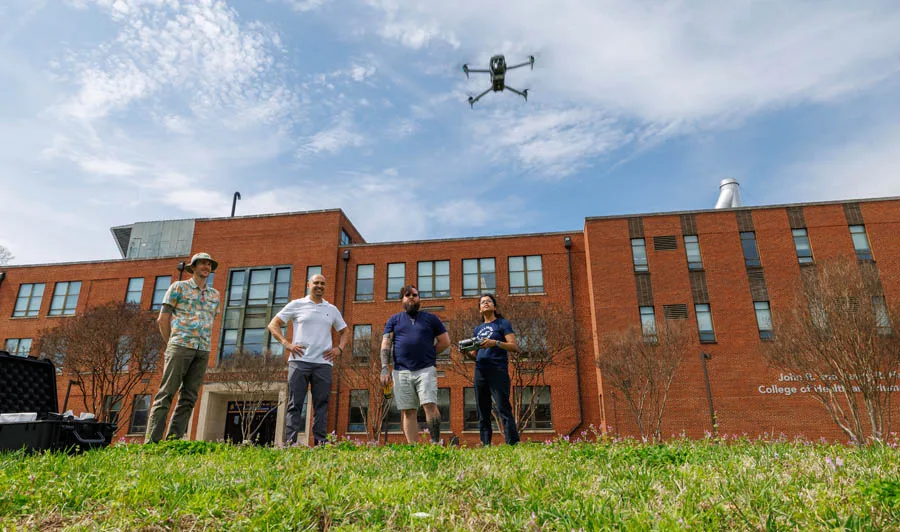
Supported by an Evans-Allen grant, the project, currently in Phase 1, launched with a demonstration flight on March 11. Harrison and a team of LDAR students performed a digital map of the Holland Bowl, an open area on South Campus centric to three residence halls and Williams Dining Hall, using a DJI Matrice 4E drone and Trimble GNSS equipment for terrain mapping.
“After working with the drones, we will be back later with iPads to scan the area at a base level and reconcile that with the 3D drone footage captured in the air,” said Harrison.
According to Harrison, the program had previously mapped the Holland Bowl with a lower resolution 3D twin in 2015.
Jordan Canal, a senior in the program, spoke to the environmental implications with using the digital twin.
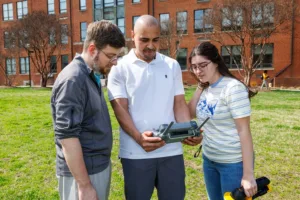
Jeffrey Kuehner, a lecturer in the landscape architecture program, and student Jordan Canal check drone footage with Harrison, center, as they digitally map a section of campus.
Later this year, Harrison said, he would like to see the technology used at one of the university’s biggest events: the 100th anniversary of the Greatest Homecoming on Earth.
For this ambitious project, he proposes loading the current Holland Bowl landscape into the digital twin as an interactive experience. Then, using a tablet, kiosk, or mobile device, visitors could write or speak how they would redesign the space.
The system would use AI to rapidly show what their ideas would look like, while at the same time also showing how their design would perform ecologically and how it would rate socially and aesthetically – would people be able to use it? Would they think it’s pleasant?
The platform could also allow multiple users to collaborate, combine ideas, and contribute personal stories or memories tied to the space.
“These inputs would be archived and could help inform future real-world design decisions,” said Harrison. “In this way, every participant truly becomes a part of the campus design process.”