
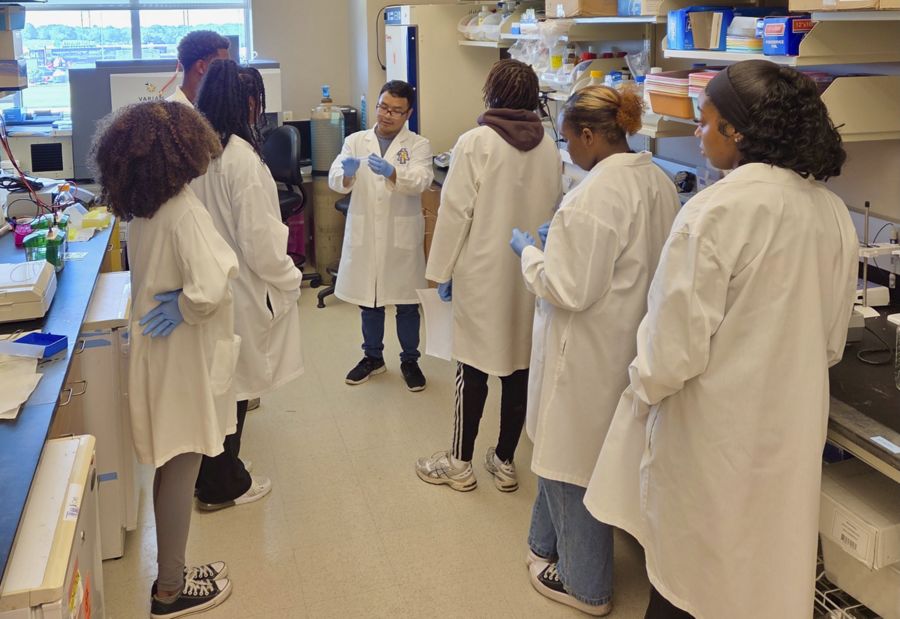
Charlotte-Mecklenburg students studying the principles of “food is medicine” got a closer look at food analysis through the labs of N.C. A&T’s Center for Excellence in Post-Harvest Technologies, or CEPHT.
Last month, the center, housed at the North Carolina Research Campus in Kannapolis, served as host to 15 high school scholars of the George Washington Carver Food Research Institute’s Explore STEAM Academy. The program, held every year by the Charlotte-based nonprofit, is a two-week training camp designed to provide a unique opportunity for prospective food science students to explore food science and agricultural innovation through interactive workshops, field trips and collaborative projects. CEPHT, part of CAES’ Department of Family and Consumer Sciences, was one of the final stops for the scholars on June 26.
“Hosting programs such as GWCFRI scholars and other stakeholder events allows CEPHT to strengthen its research ecosystem, build community ties, inspire youth, and secure future partnerships while fulfilling its mission as a center of excellence at the intersection of science, agriculture, and community empowerment,” said CEPHT Director Leonard Williams, Ph.D.
Opening the labs to the Explore STEAM students, Williams, alongside CEPHT team members Amira Ayad, Ph.D., Priscilla Randolph, Shurrita Davis, Tekan Rana and summer interns Bria Dargan and Salma Hassanein, offered experiential learning based on the academy’s theme of ready-to-use therapeutic food, with a focus on fortified, plant-based products designed for the domestic market. Under the scientists' direction, the group performed lab tests on food samples such as skim milk, fava beans and Gatorade.
Delmonica Farrior, a CAES Ph.D. student with a concentration on food science, human nutrition and health, served as a chaperone to the scholars.
“This was my first time at the center, and it was exciting to see these developments at the center along with the students,” said Farrior, a flavor assistant with flavors and fragrance company Givaudan who was invited to help with the scholars. “The center helps bring the science to real-world, real-life experiences in ways that you can’t find in a textbook or lecture.”
Farrior’s reaction mirrored that of the students.
“A lot of the students have an interest in STEM, but there was one student, her name was Kennedy, that wants to be a medical doctor,” said Farrior. ”So for her to be in the lab and see how we perform protein analysis – she was so excited that it was all she could talk about for the rest of the camp.”
Williams offered high praise to the student scholars for their participation and the prospect of creating future Aggies.
“Programs like the GWCFRI STEAM Academy introduce middle and high school students to careers in science and agriculture,” said Williams. “These experiences can feed into internships, college admissions, and future employment pipelines — potentially producing the next generation of researchers for CEPHT, N.C. A&T, and partner institutions.”


