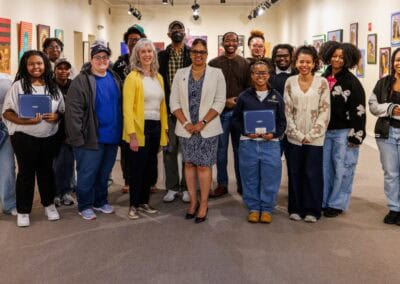
Landscape architecture student Chavious Burns transferred to N.C. A&T specifically for the program. "I've always been interested in working with underutilized spaces," he said.
Growing up in Atlanta, Chavious Burns ’23 saw plenty of urban architecture in the skyscrapers and buildings of its bustling downtown. But although he didn’t know it as such at the time, he also saw spectacular landscape architecture in the green spaces, parks and natural areas within the city.
There was Centennial Olympic Park, with its trees, lawns and sculptures, where he went to summer jazz concerts with his family. Or the 30-acre Atlanta Botanical Garden, with its vast beds of blooming flowers and manicured walkways. Both urban spaces were made vibrant and accessible by a mix of natural and built designs.
“I’ve always had a passion for transforming underutilized or ordinary spaces into memorable and sustainable outdoor spaces everyone can enjoy, I just didn’t know that I wanted to make that into a career,” Burns said. “Even as a kid, I was really intrigued by the parks and gardens. Being in that open landscape contributed to my love for landscape architecture.”
Now in his second year in the Department of Natural Resources and Environmental Design’s landscape architecture program, Burns, a junior transfer student, has found his calling. He joined the student chapter of the American Society of Landscape Architects and immersed himself in projects for his classes.
“I got to have a beautiful first-year experience before COVID,” he said. “Even with the pandemic last year, I’m still growing and cultivating my skills. I love it.”
When many people think of green space, they think of landscaping. But while landscaping focuses on the maintenance of a space, such as mowing grass and planting bushes, landscape architects focus on designing the space, placing different elements such as vegetation or even buildings, and using the topography of the land in ways that work together to make a visually pleasing, useful area. They also supervise their design’s construction.
By changing the landscape, the profession can also improve human and environmental health.
After graduating from high school, Burns went to Clark Atlanta University on a football scholarship, playing outside linebacker. But a movie that he had watched years earlier, in which the main character transforms his romantic interest’s ordinary yard into a luxurious landscape, stayed fresh in his mind.
“The character was a professional landscape architect, and I had never put a name with the profession until I saw that movie,” he said. “After that, I did some research and found out about the profession, and decided that it was the path I wanted to pursue instead of football.”
Burns also discovered NRED’s landscape architecture program and determined that it had everything he needed to become a licensed landscape architect.
“That’s the thing about A&T – if you study hard and prepare yourself, there are so many opportunities here,” he said. “I’m really thankful for it.”
One of those opportunities will come this summer, when Burns will have an internship with professional landscape architect Andrew Sargeant. Sargeant is the recipient of the national Enterprise Rose Fellowship, which was started by philanthropist and developer Frederick P. Rose to create or preserve sustainable, healthy and affordable housing across the country. As part of this fellowship, Sargeant and Burns will work on re-interpreting a public space in Cleveland.
“One of the great things about landscape architecture is that it can create healthy, vibrant areas in communities that have not necessarily been treated equitably in city planning,” said Chris Harrison, assistant professor and coordinator of the program. “I predict that Chavious will do well – he is extremely intelligent and insightful, and combines hard work, good humor and talent to consistently set the bar for everyone in his courses.”
Although graduation is two years away, Burns can already envision his future plans: to work with a landscape architecture firm after graduation and eventually start his own.
“I feel very comfortable going out into corporate America, because the program has prepared me to be successful,” he said. “Dr. Harrison has taught us skills and tactics, brought in speakers and provided internship opportunities, and he’s always accessible.”
Although Burns is still an avid football game-watcher, he knows landscape architecture is the right career path.
“N.C. A&T’s landscape architecture program will always play a pivotal role in my life and have a special place in my heart because this was the place that provided me with the opportunities,” Burns said. “As I look back, I’ll always remember that this was where I started.”