CaesNews

Where Science Meets Society

Logo featuring the letters "A" and "T" in blue and gold, representing North Carolina Agricultural and Technical State University.

CaesNews

Where Science Meets Society

Home

Sign up for the Newsletter

Extension Brings Communities Together in the Garden

|

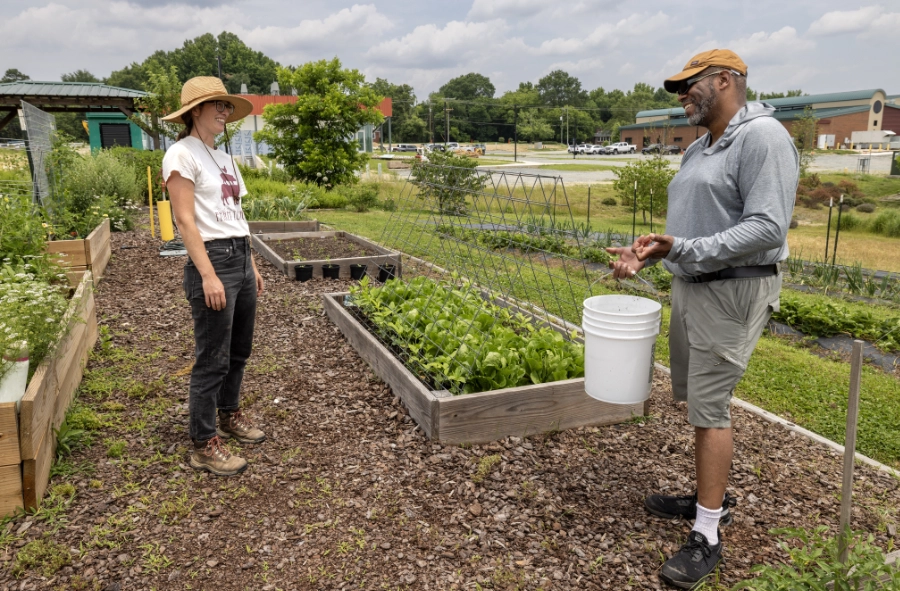
Two people stand and talk in a community garden next to raised beds filled with leafy green plants, with various gardening tools and buildings visible in the background on a partly cloudy day.

Will Ragin, a regular volunteer at the community garden on the N.C. A&T State University Farm, works with Morgan Malone, Extension associate for Urban Agriculture and Community Gardens, on some of the 10 beds planted this spring.

Rhonda Watlington had every intention of starting a small garden three years ago when she bought a raised gardening bed, but …

“It’s still in the box … it’s still in the garage,” she said, admitting to being a bit intimidated by starting a garden when she has no experience.

Two women stand and chat in a community garden. One wears a pink cowboy hat and green t-shirt, the other wears a wide-brimmed straw hat, glasses, and holds papers. Raised garden beds and greenery appear in the background.

Rhonda Watlington, left, chats with Malone during an event at the University Farm’s community garden.

However, through a joint venture of Cooperative Extension at N.C. A&T and the College of Agriculture and Environmental Sciences at N.C. A&T State University, Watlington is finding the resources and the incentive she needs to dig that box out of the garage and start growing.

Extension and the college run the Student and Community Farm at the University Farm on McConnell Road. And while there a few rental spaces set aside for gardening, “the community garden is really meant to be an outreach opportunity for people to learn more about community gardening and how they can get involved in their area,” said Morgan Malone, urban agriculture and community gardens coordinator for Extension.

There’s also a high tunnel structure available, allowing community gardeners to get a jumpstart on the growing season.

“My role is to support community gardens and urban ag projects across the state, primarily in our urban areas, but also in our rural areas,” Malone said, “to make sure they get the support and resources they need to be successful over the long run.”

North Carolinians interested in joining a community garden can email Malone at mlmalone@ncat.edu to find out what gardens are available near them. The Extension offers help with starting a community garden, facilitating an interest meeting and developing a financial plan.

The program also offers a Community Garden Leadership Academy at locations around the state, Malone said, “to teach people the foundational skills of leadership and community garden management.”

A man wearing a tan cap, sunglasses, and gray clothes kneels next to a raised garden bed, smiling while working in a vegetable garden. A white bucket sits nearby, and green plants and farm buildings are in the background.

Will Ragin, a regular volunteer, works in the University Farm’s community garden.

University Farm community garden volunteer Will Ragin, a Guilford County master gardener, said community gardens are extremely important to fight food insecurity and to improve the health of residents by allowing them to reconnect with nature.

“A lot of people are intimidated by gardening,” Ragin said. “They also think it takes a tremendous amount of time.” But community gardens allow them to “take baby steps,” he said.

Watlington looks forward to working with Malone to get her own garden established. “I’m one of those learners who wants to see somebody who is successful — and/or not — and talk to specialists,” she said. “I have a lot of questions in reference to getting started.”

Watlington anticipates the garden will save her money at the grocery store, as well as encouraging her to eat a healthy diet and feel good about cooking what she’s grown. She plans to start out with herbs and work her way up to other vegetables, such as tomatoes.

“I'm gonna walk outside on my patio and to my raised bed and get a few mint leaves and some cilantro. That makes me feel like I'm really engaged in cooking, and I know … the product that I'm growing,” Watlington said.


Would you like to learn more about N.C. A&T State University?

Founded in 1891 in Greensboro, North Carolina, N.C. A&T is the nation’s largest historically Black university and a premier 1890 land-grant doctoral research institution. Home to more than 14,000 students, A&T is nationally recognized as the top public HBCU in the country and the number one producer of Black graduates in engineering and agriculture. With over $2.4 billion in annual economic impact, the university combines rigorous academics, pioneering research, and a vibrant campus culture to prepare the next generation of global leaders. 

Read more CAES News

Extension Helps Reserve Unit Understand the World’s Most Important Protein Source

Extension Helps Reserve Unit Understand the World’s Most Important Protein Source

As someone with more than a decade of military experience, including the last two years with an Army Reserve Civil Affairs unit, William Landis knows that building trust and understanding with communities around the world often starts by understanding the animals they raise and depend on for food.
Dale honored for completing Food Systems Leadership Program

Dale honored for completing Food Systems Leadership Program

Associate Dean and Extension Administrator Rosalind Dale of North Carolina Agricultural and Technical State University has been honored for completing the Food Systems Leadership Institute, a two-year executive leadership development program.
36th Annual Celebration of Small-scale Farming in North Carolina set for March 21 – 26

36th Annual Celebration of Small-scale Farming in North Carolina set for March 21 – 26

North Carolina Agricultural and Technical State University’s annual tribute to small-scale agriculture will begin March 21 and will feature educational programs, panel discussions, tours, and the unveiling of a new Small Farmer of the Year.
The Student Perspective: CAES students join faculty, policymakers to discuss food security  

The Student Perspective: CAES students join faculty, policymakers to discuss food security  

People from all sides of the food distribution chain, including policy makers, students, Cooperative Extension agents, community leaders and interested community members, came together at the Farm Pavilion recently to talk about food: who needs it, who has it, and how to bridge the gap.
No results found.