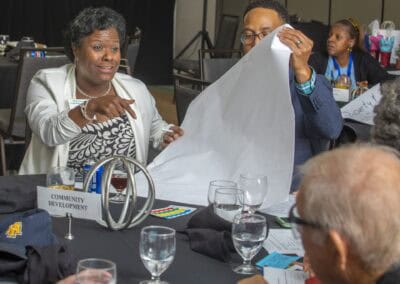
Attendees listen attentively as Hemp Conference panelists explain changes in hemp regulations and state laws..
More than 250 industry partners, Extension agents and farmers from across the state came to the campus of N.C. A&T on Feb. 11 to learn the latest tips and information for growing industrial hemp during the university’s first Hemp Conference.
Attendees heard presentations from A&T, NC State, the N.C. Department of Agriculture and Consumer Services, and industry researchers and experts about the basics of hemp growing, marketing and budgeting; the projected economic outlook for growers; and the best production practices for long-term success.
A panel comprised of members of the N.C. Industrial Hemp Commission, the board charged with overseeing the development of hemp as a viable crop statewide, discussed changes in regulations governing hemp cultivation.
Exhibitors, including greenhouse owners and hemp product developers, were also on hand to share information and answer questions.

Hemp has the power to be a “transformative” crop for N.C. agriculture, explains Chancellor Martin.
Chancellor Harold L. Martin Sr. encouraged the group to use N.C. A&T’s researchers as a resource when getting involved in this emerging market.
“As a young boy growing up in the South, I remember the acres and acres of tobacco fields” that used to define the landscape, he said. “Who would have known that those tobacco fields would open up to new opportunities? We will keep exploring the possibilities so that we can open up new opportunities for you.”
Interest in industrial hemp has exploded since changes in state and federal law have allowed its cultivation again after nearly a century of dormancy. Hemp was once widely grown in the U.S., including North Carolina, before becoming illegal in the 1930s because of its similarity to marijuana. Now, the USDA and state agriculture advocates are interested in resurrecting hemp as a viable cash crop.
In North Carolina, there are nearly 1,500 licensed growers using more than 17,000 acres of land, with another 6.7 million square feet of licensed greenhouse space devoted to industrial hemp, according to the N.C. Hemp Commission.
“Hemp could make a big difference for North Carolina farmers,” said Guochen Yang, Ph.D., a professor in the Department of Natural Resources and Environmental Design and a member of the Hemp Commission. “It has the potential to be a high-dollar, sustainable domestic crop such as we haven’t had in a while.”

Best growing practices and marketing strategies were among the topics that more than 250 attendees heard at A&T’s first Hemp Conference.
However, industry professionals cautioned that participating in the fledgling industry is a balance of risk and reward.
“This is an industry in its infancy,” cautioned Tom Melton, Ph.D., the Hemp Commission’s chairperson. “The regulatory environment is changing, as well as best practices. There is tremendous opportunity, but our advice is to start small.”
Local builder David Millsaps came to the conference to investigate possibilities for using the 40 acres of his grandparents’ former Alexander County tobacco farm. The information presented gave him definite food for thought.
“I’d like to do something with that land,” he said. “Hemp may just be it. This is definitely a lot of good information.”
This hemp conference is likely to be the first of many, said Mohamed Ahmedna, Ph.D., dean of A&T’s College of Agriculture and Environmental Sciences.
“As the information changes, as we learn more, we will be here to share our information with you,” he told attendees. “We are here to help you be successful.”