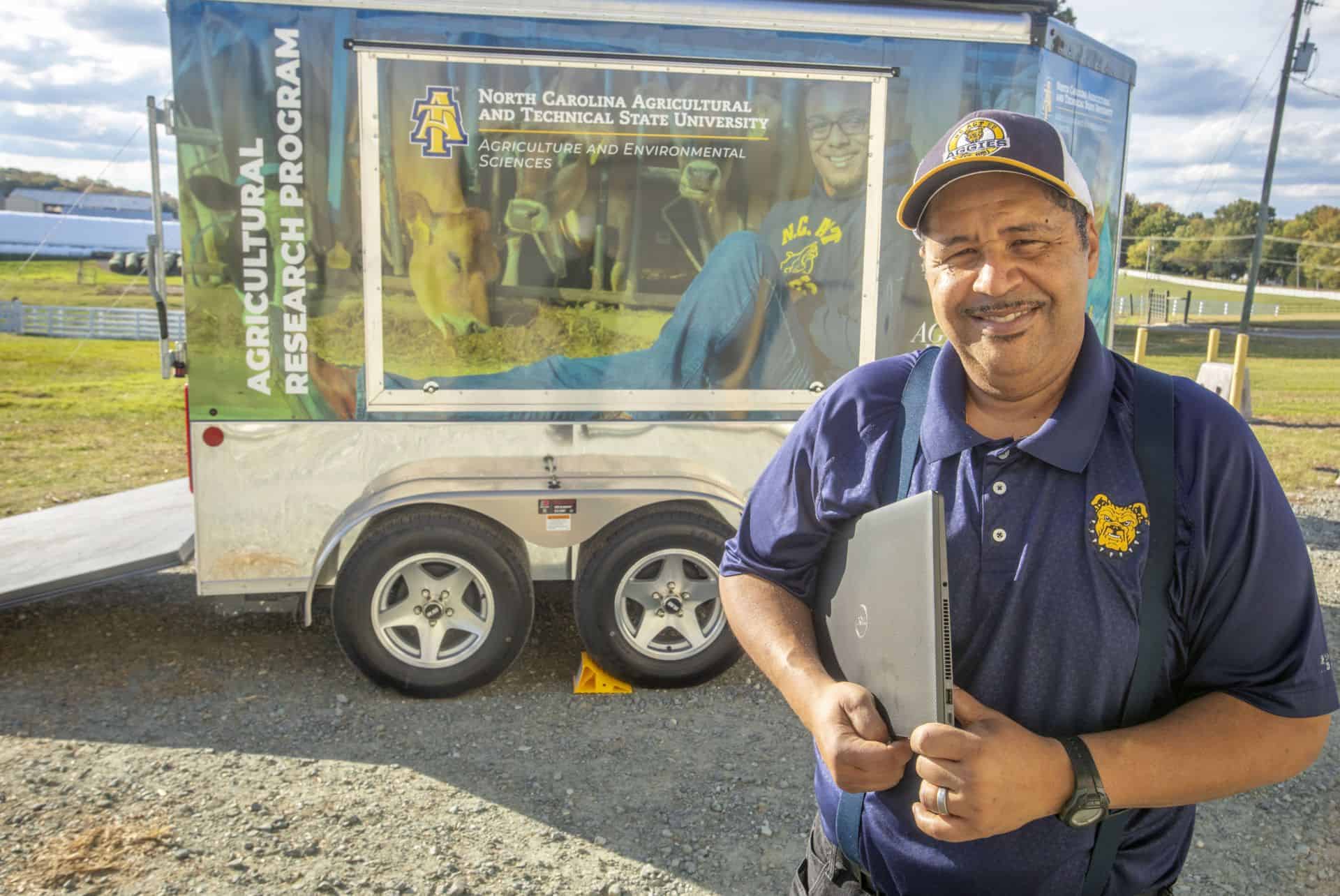
A former NASA scientist and nationally recognized research leader, academic administrator and innovator, whose career reflects a sustained commitment to advancing student success, agricultural innovation, and the land-grant mission, has been appointed dean of N.C. A&T’s College of Agriculture and Environmental Sciences following a nationwide search.
Gregory D. Goins, Ph.D., will begin his new role Aug. 17.
"Throughout the search process, Dr. Goins distinguished himself through his vision for the future of the college, his collaborative leadership style and his demonstrated ability to build programs that achieve excellence and impact," said Provost Andrew Daire.
Goins is currently the associate dean for agricultural research in the college, a role he has held since 2022 having previously served as chair of the Department of Natural Resources and Environmental Design. As associate dean, he provides strategic oversight of the college’s $45 million research enterprise while advancing faculty success, graduate education, infrastructure development and external partnerships.
During his tenure, Dr. Goins founded the Small Farms Resource and Innovation Center (SFRIC) , creating a signature institutional platform focused on strengthening small farms through applied research, experiential education, technical assistance, entrepreneurship, and innovation-driven partnerships.
He has contributed to national agricultural policy and strategic priorities through his service on the USDA Advisory Committee on Beginning Farmers and Ranchers and as chair of the USDA Specialty Crop Committee, helping shape programs that support producer success, agricultural competitiveness and rural prosperity.
In 2024, he helped secure a National Science Foundation Regional Innovation Engine initiative designed to establish a 42-county Agricultural Technology Innovation Corridor across North Carolina. This effort brings together universities, industry, nonprofit organizations, and community stakeholders to accelerate entrepreneurship, strengthen agricultural competitiveness, and expand participation in innovation collaborations across agricultural communities.
During eight years as a scientist at NASA Kennedy Space Center, Goins led pioneering research in controlled-environment agriculture and received NASA’s highest scientific research recognition for designing plant growth experiments conducted aboard both the Space Shuttle and the International Space Station. This work advanced the understanding of biological systems in extreme environments while contributing foundational knowledge to future food-production technologies.
He expanded his national impact through service as a Program Director at the National Science Foundation, overseeing investments in the Noyce, Improving Undergraduate STEM Education (IUSE), and Scholarships in STEM (S-STEM) programs. Through this work, he helped shape national efforts to strengthen STEM education, broaden participation, and improve pathways to student achievement and workforce development.
In recognition of his leadership in advancing student success and interdisciplinary education, Dr. Goins was recognized by the Obama White House in 2015 as a Champion of Change for contributions to biomathematics—an emerging interdisciplinary field that integrates biological sciences with mathematical, statistical, and computational approaches to solve complex societal challenges.
"My leadership philosophy is rooted in the belief that N.C. A&T is uniquely positioned to lead the future of agriculture, science, and economic mobility through excellence in discovery, student-centered innovation, and purposeful community engagement," he said. "I believe in expanding opportunity, accelerating innovation, and translating research into measurable impact for students, communities, and agriculture."
Goins earned his B.S. in biology from the University of North Carolina – Chapel Hill and his M.S. and Ph.D. in crop physiology from N.C. State University. He completed postdoctoral training with the U.S. Department of Agriculture in St. Paul, Minnesota.