CaesNews

Where Science Meets Society

Logo featuring the letters "A" and "T" in blue and gold, representing North Carolina Agricultural and Technical State University.

CaesNews

Where Science Meets Society

Home

Sign up for the Newsletter

July 2021 News and Notes

|

Grad Student Receives Wastewater Research Funding

Jonae’ Wood, a master’s student in agriculture and environmental sciences, has received funding for her wastewater research project thanks to the N.C. Water Resources Research Institute and the Urban Water Consortium.

Advised by faculty member Niroj Aryal, Ph.D., she is investigating how to more efficiently remove pollutants from municipal and food processing wastewater. The research institute is a federal-state partnership with funding through the U.S. Geological Survey in the U.S. Department of the Interior.

Faculty Promoted, Exceed Expectations

Several CAES faculty members have been promoted, effective July 1:

  • Chastity Warren-English, associate professor, was promoted to full professor, Agribusiness, Applied Economics and Agriscience Education, College of Agriculture and Environmental Sciences
  • Uchenna Anele, assistant professor, was promoted to associate professor with tenure, Animal Sciences, College of Agriculture and Environmental Sciences
  • Yewande Fasina, assistant professor, was promoted to associate professor with tenure, Animal Sciences, College of Agriculture and Environmental Sciences

Other faculty members received “exceeds expectations” in their post tenure reviews:

  • Osei Yeboah, professor, Agribusiness, Applied Economics and Agriscience Education, College of Agriculture and Environmental Sciences
  • Radiah Minor, associate professor, Animal Sciences, College of Agriculture and Environmental Sciences
  • Lijun Wang, professor, Natural Resources and Environmental Design, College of Agriculture and Environmental Sciences
  • Guochen Yang, professor, Natural Resources and Environmental Design, College of Agriculture and Environmental Sciences


Would you like to learn more about N.C. A&T State University?

Founded in 1891 in Greensboro, North Carolina, N.C. A&T is the nation’s largest historically Black university and a premier 1890 land-grant doctoral research institution. Home to more than 14,000 students, A&T is nationally recognized as the top public HBCU in the country and the number one producer of Black graduates in engineering and agriculture. With over $2.4 billion in annual economic impact, the university combines rigorous academics, pioneering research, and a vibrant campus culture to prepare the next generation of global leaders. 

Read more CAES News

Summer Science: Program Creates Research Apprentices

Summer Science: Program Creates Research Apprentices

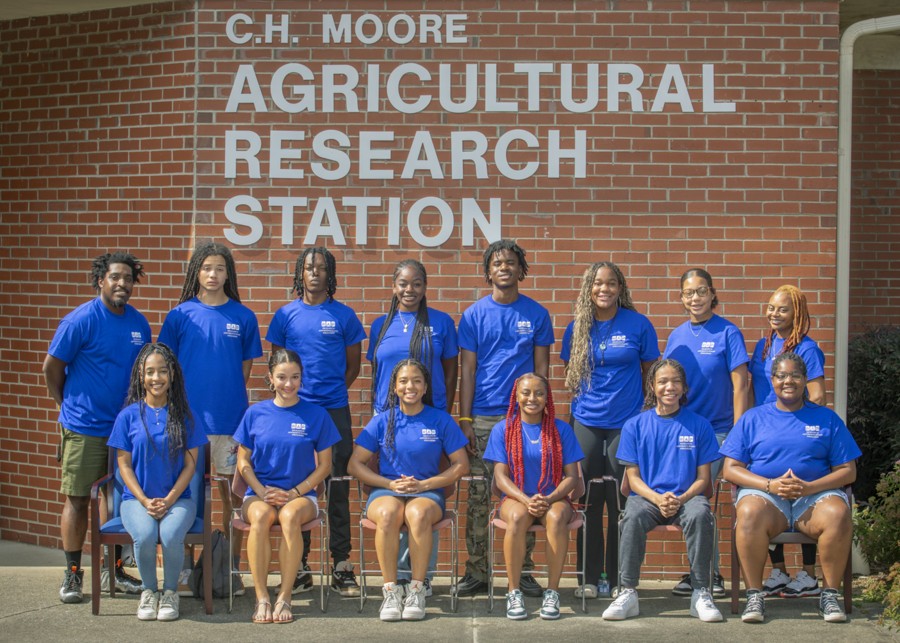
Twelve high school students across the United States became the latest crop to leave with hands-on learning and networking opportunities in the College of Agriculture and Environmental Sciences’ Research Apprenticeship Program.
Blevins Named Assistant Administrator of Cooperative Extension

Blevins Named Assistant Administrator of Cooperative Extension

Mark Blevins, Ed.D., has been appointed Cooperative Extension at N.C. A&T’s new assistant administrator for agricultural and natural resources. Previously the Brunswick County Extension Director, Blevins earned his bachelor’s and master’s degrees in agricultural extension with a concentration in horticulture from NC State University, and went on to earn his doctorate in Extension education at NC State as well.
Fashion Students Celebrate Spring with Runway Show, Internship Opportunities

Fashion Students Celebrate Spring with Runway Show, Internship Opportunities

Earth, air, water, fire and fabric took center stage this spring at the Fashion X-Cetera runway show.
Cooperative Extension shares successes in two new DIGITAL publications

Cooperative Extension shares successes in two new DIGITAL publications

For Cooperative Extension at N.C. A&T, the last program year has been one of success in the face of unprecedented challenges. The new online publication Solutions for North Carolina documents some of those successes as well as the efforts taken by Extension staff on campus and in the field to adapt their programs and offer education as limited-resource farmers and communities struggled with the uncertainty caused by the COVID-19 pandemic.
No results found.