Landscape Architecture students and faculty work around the gravesite of Charlotte Hawkins Brown at the Palmer Institute on a project to honor her that they have designed and are now building.

*Charlotte Hawkins Brown archive picture– Dr. Charlotte Hawkins Brown, founder of the Palmer Memorial Institute in Sedalia, was an author, educator and civil rights activist.
The students began work last spring on a project to design and build a memorial at Brown’s gravesite, located at the school she began: the Palmer Memorial Institute in Sedalia.
“The students … created an initial design, reviewed it with the client, and then finalized it this fall,” said Steve Cancian, an assistant professor in the landscape architecture program, within the Department of Natural Resources and Environmental Design.
“They’ve been doing construction on the site for the last six weeks. The critical step here is the students have gone from just making drawings to being responsible for actually creating the landscape. That teaches them lessons you can’t learn anywhere but out here in the field,” he said.
The program partnered with the General Federation of Women’s Clubs of North Carolina to create the memorial design.
Born in Henderson in 1883, Brown founded the Palmer Memorial Institute in 1902 as a day and boarding school for African American students. Named after Alice Freeman Palmer, the Massachusetts Board of Education member who paid for Brown’s schooling expenses, the institute originated in a blacksmith’s cabin before Brown raised the money to buy 200 acres and build two new buildings for the campus. By 1970, more than 1,000 Black students had attended the school, one of the only of its kind in the state that offered college preparatory programs to minorities.

Brown’s gravesite on the final day of construction in fall ‘22.
After closing in 1971, the institute reopened in 1987 as the Charlotte Hawkins Brown Museum at the Palmer Memorial Institute State Historic Site. It has been listed on the National Register of Historic Places since 1988.
“I think it’s so important for these students to come to get this experience,” said Tanesha Anthony, a site manager at the Charlotte Hawkins Brown Museum. “Having students from a historically Black university working on a historically Black institute like Palmer - it just feels ‘full circle’ to have them come and do the work to commemorate Dr. Brown’s gravesite.”
Senior Octavia Coleman said the beautification was part of “making a more comfortable space for people to visit her (Brown) and pay their respects.”
“She was an important person in African American society, especially back in the day,” Coleman said. “She created this school for them to help them better themselves. Just to honor her and create a space that reflects and respects her is important.”

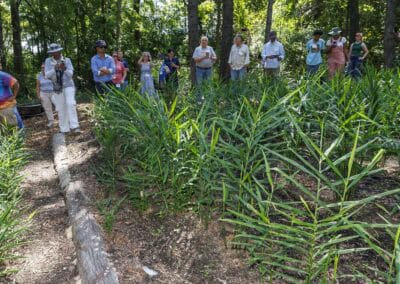
Steve Cancian, associate professor in the landscape architecture program, speaks to a group of students invited to help plant at the Palmer Institute on October 24th
The senior class planted more than 200 trees, shrubs and perennials, and built a stone wall around Brown’s gravestone. Fellow students and faculty in the program were invited to assist with the planting.
“This is important because of Dr. Brown’s legacy, and what she meant to this area and to African American students,” said senior Chavious Burns. “She was a trailblazer for creating educational opportunities for students who couldn’t study in other schools in the area (because of segregation). She created a place for them to come. For A&T to come back and pay it forward means a lot.
The students planted evergreen and deciduous trees at the memorial as well as flowers with white and yellow blooms.
“The colors mean a place of peace, of serenity for the gravesite, and the yellow comes from the Canary Cottage,” said senior Silas Lindsey, referring to Brown’s Dutch Colonial personal residence at the site. “This building has been painted this color since its days as an operating prep school, and we know that Charlotte Hawkins Brown also owned canaries.”
Cancian said the team will next work on cosmetic adjustments to the gravesite’s sidewalk and installing plaques. Final construction is set to continue next spring.
Senior Ivan Vazquez said the process of taking the project from the initial design concept to its near-final stages proved eye-opening not only for his own professional insight but for honoring Brown’s memory.
“This project is important for us, as students, because it helps us see what the profession is going to like after we graduate, but also because we felt that before, the site wasn’t really honoring her legacy,” Vazquez said. “We believe our design fulfills it.”

Senior Chavious Burns helps plant a tree at the gravesite of Charlotte Hawkins Brown.