N.C. A&T faculty, local farmers, food & health organizations and city government came together recently to combat food insecurity and “put the ‘green’ back in Greensboro” in a sustainable agriculture summit.
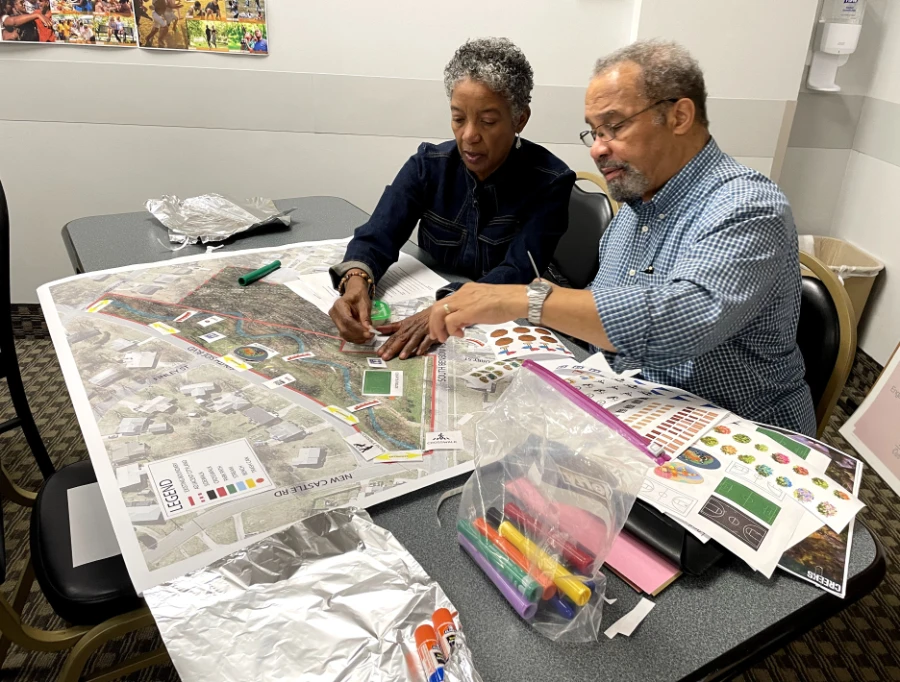
On March 22, the College of Agriculture and Environmental Sciences, along with partner universities and the City of Greensboro, hosted a “Love the Food, Hate the Waste” symposium at the University Farm Pavilion a collaborative event designed to provide an open forum for discussing issues encircling food waste and recovery solutions in Greensboro.
“We’re really thrilled having the diversity of backgrounds as they will help us find solutions to reduce food wastes here in Greensboro,” said horticulture lecturer and Reid Greenhouse director Odile Hutchette. “Today is not just about talking; today is about brainstorming and finding solutions. Our goal is to open the door to more collaborations and help us improve the situation.”
In opening remarks, Shree Dorestant, Ph.D., chief sustainability officer for the City of Greensboro, said that food waste became “one of the biggest topics” of discussion as she joined the city in June 2022.
“To me, awareness is everything: how can we do more education about this topic?” said Dorestant. “I hope today’s event has some major takeaways that we can really chew on to really bring the “green” back in “Greensboro.”
“We, in the United States, are very lucky and fortunate to have plenty of food unlike many other parts of the world,” said CAES Dean Mohamed Ahmedna “But, at the same time, we’re also faced with a challenge: on one hand, we waste 30 to 40 percent of our food production, at an estimate of between 120-200 billion pounds, each year. On the other hand, we have, I believe, over 35 million people who are food insecure, and most of whom are kids. That contrast is what we have to do something about.”
Marikay Abuzuaiter, an at-large Greensboro City Council member, spoke about her personal experience with food waste during the 22 years she owned a restaurant.

Greensboro City Council at-large member MariKay Abuzuaiter spoke about the food waste she encountered in her 22 years of owning a restaurant. “At one time...we couldn’t take the food we had left over from a banquet to feed the homeless because of the (food) safety issue,” she said.
“During all of those years, I was worried about food safety, of course,” said Abuzuaiter. “But at one time, we could not take the food we had left over from a banquet to feed the homeless or let anyone else eat after the event because of the safety issue. I understood all of that, but if you take care of the food in the proper way and the proper technique, it can hold up to four hours at a certain temperature. Inspection said it still couldn’t happen because it was still after the banquet, and I said, ‘Yes, but someone is starving.’ I didn’t get far with that but knowing that this group is passionate about zero food waste is what we need.”
Attendees from Guilford College, Cone Health and Biofuel/Biodiesel 4 Schools, the College of Agriculture and Environmental Sciences and local farmers spoke about the food waste problem and creative ways to repurpose food, such as for animal feed; and reduce waste, by source reduction, composting or industrial uses.
“All of the resources that go into producing the [wasted] food contribute to greenhouse gases,” said William Randle, Ph.D., a professor in the Department of Natural Resources and Environmental Design. “But, when we put that food into the landfill, it produces multiple greenhouse gases: methane and carbon dioxide. The significance of methane is that it is 25 percent more effective at holding in heat than carbon dioxide, so this is something that we really have to get a handle on.”
Irma Marerro, owner of Petite Green Giants in High Point, said her family-owned microgreen farm reduces waste by converting unsold or “less-than-perfect” produce into a dehydrated powder.
“We mixed the powder with my favorite Himalayan sea salt, and it flew off the shelves,” said Marerro. “One day, my husband, now-director of marketing and branding, decided to switch his 3 p.m. espresso for tea and brewed the microgreen powder. That changed everything. Now, we sell the microgreen powder on its own, and when we’re selling it as a tea, we can’t keep it on the shelves.”
Campus dining facilities can help the problem too, said Roman Whitaker, an A&T graduate student. Offering takeout options and reducing plate portions to avoid over-piling, and donating un-bought food could help, he said.
“There are local organizations city-wide that are dedicated to food donations,” said Whitaker. “They aid in helping to prevent food insecurity. Most municipalities and educational institutions have pantries and food kitchens devoted specifically to help those in need.”
Part of the event was a poster contest, featuring abstracts from undergraduate and graduate students in Greensboro representing various ways to prevent and divert food waste.
The “Love the Food, Hate the Waste” symposium was sponsored by N.C. Cooperative Extension, UNC-Greensboro, Guilford College, A Simple Gesture, Mary B’s Southern Kitchen, Deep Root Market, The Fresh Market, Food Lion and Chic-Fil-A.