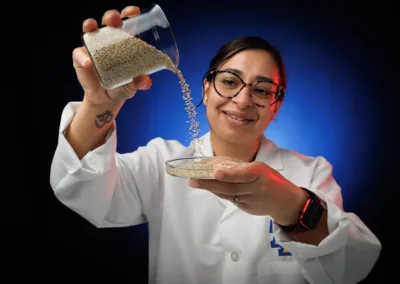
Master's student Janeva Williams, who has received a prestigious Encompass Fellowship from the Crop Science Society of America, runs some lab tests in Carver Hall.

Janeva Williams
That all changed after graduating high school in 2013 and moving to Durham to work for her father’s new landscaping business. While digging and planting, she developed an intense curiosity and desire to learn more about the natural environment and soil beneath her feet. She also knew that nearby North Carolina Agricultural and Technical State University would be the best place to do so.
“It’s a totally different world underneath there that we do not know about, yet we use that to grow our food and build our land. So I thought, “This is it. This is my major.’ ”
Williams’s realization paid off this fall, when she received a prestigious Encompass Fellowship from the Crop Science Society of America, Agronomic Society of America and Soil Science Society of America. Part of the fellowship entailed a weeklong leadership conference in Salt Lake City in November, a Congressional Visits Day in Washington D.C. in March and a series of professional development workshops. She also will be assigned a year-long mentor.
In its acceptance letter to Williams, the fellowship committee stated, “You nomination was a stand-out as evidenced by your leadership, DEI, and impact statements and letter of reference.” (The acronym DEI stands for diversity, equity and inclusiveness.)
Although soil science expert Arnab Bhowmik, assistant professor in the Department of Natural Resources and Environmental Design, was pleased, he was not surprised by Williams’s success.
“She is hard-working, bright and proactive in trying to develop leadership skills. I’ve been seeing that since the first day I met her. I saw the spark in her eyes,” Bhowmik said.
Once at N.C. A&T, Williams’s undergraduate major in Agriculture and Environmental Systems shaped her interest further, and coalesced even more during her junior year after meeting her new advisor, Bhowmik.
She told him soil was her real interest, and that’s when she got a bigger picture of the science. Soon after, she landed a summer internship with the Soil Health Institute in Durham.
“That was a game changer,” she said.
During the internship, she gained an appreciation for the connections between research, field work and office work, which involves meetings and networking and applying the science to the real world of production agriculture. She used that broader understanding to focus her interests further.
Today, as a master’s student in Agriculture and Environmental Systems and graduate research assistant in Bhowmik’s Soil Microbiology Laboratory, she has her sights set on a career as a soil consultant while researching climate-smart soil management practices.
Williams’s enthusiasm has caught national attention. In addition to the Encompass Fellowship, she was also recently selected one of six national 2021 Farm Foundation “cultivators,” a designation awarded to exceptional students by the Farm Foundation, an agriculture advocacy group.
Bhowmik says her national awards are beneficial not only for her professional development, but also for the CAES and university as a whole in raising awareness of the college and university’s contributions to science.
“It means A&T and the college are getting represented at the highest levels where policies are made. It’s a brand statement for A&T,” he said.
Williams says she too, sees herself as a leader one day, but has not yet committed to a single career. She sees a Ph.D. somewhere in her future as well as research, or work as a consultant, but at this stage she is aiming for a starting job in her field that will incorporate abundant opportunities to learn and travel abroad.
“I need to understand this world we live in before I really buckle down and decide what work I want to do and what projects I want to take on,” she said.