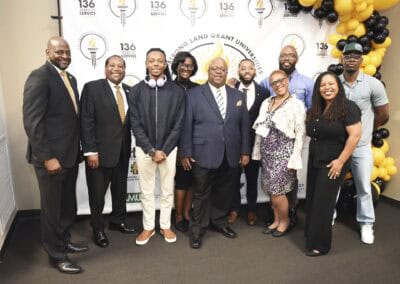
Last summer, Taylor Mitchell ‘22, environmental studies major, walked the halls of Capitol Hill as the inaugural 1890 Universities Foundation intern on the U.S. House Agriculture Committee.
This summer, Mitchell is earning her master’s degree and is looking forward, with an appreciation for her internship experience and where it has taken her so far in her career.
“N.C. A&T is a STEM school, so my classes were more focused on research and the science behind it,” said Mitchell. “But the agriculture committee was working with the legislation that allows that research to happen. So I learned that you can have science and research involved in policy.”
Started in 2022, the 1890 Universities Foundation Internship seeks to connect students from universities within the 1890 land-grant system to public policymaking.
“The internship is an invaluable way for students to gain an understanding of Congress and its processes,” said Antonio McLaren, Ed.D., vice president for program innovation and implementation at the 1890s Universities Foundation, a nonprofit organization which supports education, academics and outreach across 19 1890 land-grant universities.
“It’s critical that diverse voices are present in the policy area. These internships could lead to employment opportunities with a range of organizations and federal agencies, such as the U.S. Department of Agriculture; opportunities to work in congressional staff positions; for agri-business corporations; or in other important capacities,” he said.
While on Capitol Hill, Mitchell got a first-hand look at policymaking and the legislative processes affecting agriculture, including production and commodity prices, farm credit and farm security, rural electrification and soil conservation. She also participated in research and worked with the committee’s chair, Rep. David Scott (D-Ga.).
“Sitting in when the representatives are in session and discussing the different topics that were to come through our office, I saw how important this work is,” said Mitchell. “One discussion about how cryptocurrency could affect agriculture. Policies that can affect Black farmers when they come to the U.S. Department of Agriculture all run through this committee. I was so excited to be a part of it.”
During her time at N.C. A&T, Mitchell was highly involved as a Student Government Association senator; president of the Earth and Environmental Science Club; and a member of the CAES Dean’s Student Cabinet. Godfrey Uzochukwu, Ph.D., in the Department of Natural Resources and Environmental Design, was a special mentor for her with his talks about both sustainability and responsibility.
“We all loved Dr. Uzo. He really stayed on us about being the best student we could be, always showing up, making yourself irreplaceable in any space you’re in,” she said.
Since returning from the capital., Mitchell has pursued a master’s degree in sustainable systems at the University of Michigan with the ultimate goal of earning her Ph.D. She has also held an internship at a University of Maryland research lab, working on measures for the Chesapeake Bay Report Card, an environmental and social analysis of the health of this important, and recovering, watershed. Her studies in Michigan have focused on freshwater management, conservation and minority agriculture rights.
Eventually, Mitchell said, she would like to conduct global research on wetland conservation and securing fresh water for impoverished communities. For now, though, she plans to pursue policymaking.
“I had a great experience in D.C.,” she said. “A&T has always been about preparing you for every kind of situation, and I definitely felt prepared just knowing about agriculture, thanks to the curriculum in the CAES. I wouldn’t have been as confident in what I’m doing now if I hadn’t started there.”