Chris Broberg and Heather Haley hope to increase the variety of what they grow at their farm, Broley Homestead, in Ramseur, N.C.
“Iris is the main crop, but we’re looking at expanding into other products,” said Broberg, who attended the 2025 Small Farms Field Day with Haley, his wife.
“The poster sessions were great,” Broberg said, adding that they learned things that they could apply not only to iris production, but to other crops they might grow as well.
“It’s been really great to learn about the new things happening at N.C. A&T,” Haley said, especially in the area of sustainability, which they focus on at their farm.
About 125 people participated in the annual field day at the N.C. Agricultural and Technical State University Farm on June 20. The event, sponsored by Cooperative Extension at N.C. A&T, featured different tracks for horticulture and livestock that included tours of farm facilities and fields.
Along with an expanded livestock track, there were two new activities this year: a seed giveaway and a “Stop the Bleed” workshop — both of which were popular among participants, said Trequan McGee, Ph.D., assistant professor of practice and Extension horticulture specialist.

Small Farms Field Day attendee Taylor Marshall gives a squeamish look as she practices techniques to stop blood flow on a silicone limb.
In the workshop, participants got a hands-on experience with putting practice tourniquets on each other and applying compression to a “limb” made out of silicone with simulated wounds.
Bleeding out is the number one preventable cause of death in rural America, said Crystal Cook-Marshall, Ph.D., N.C. A&T Cooperative Extension associate and director of NC AgrAbility.
Watch Presentations From the Field
“What compression does is it can keep someone from bleeding out,” she said, also noting that using a tourniquet won’t cause somebody to lose their limb, “but they might lose their life if you don’t use it.”
The seed giveaway — which organizers hope to turn into a seed swap at future field days — offered a variety of herb and vegetable seeds, five varieties of basil plants, and “we were even able to give away a few ginger rhizomes, as well,” McGee said. About 50 people participated in the seed swap.
“Next year we’re hoping to make it a more traditional seed swap, where everyone brings their own seeds, and have more information on how they can start saving seeds,” said Morgan Malone, urban agriculture and community gardens coordinator for Cooperative Extension.
The agriculture horticulture track featured how-tos for trellising tomato plants, scouting for plant diseases, transplanting ginger and assessing soil health.
The livestock track featured how-tos for managing swine under hoop structures, assessing small ruminant health, rotating beef cattle while grazing, and checking for mastitis (an inflammation of the mammary gland) in dairy cattle.
“We learned a lot about the parasite problems we’ve been having,” said Frank Holder, who owns a small farm in Tobaccoville, N.C., with pigs and chickens. “It’s just a nice program, I hope we can come to a few more.”
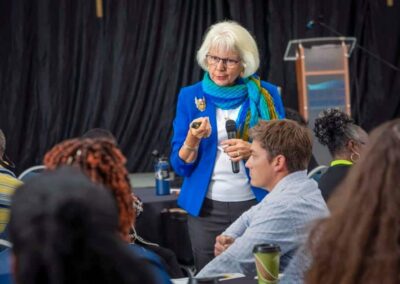
Malone presented a session on asset mapping, which involves identifying what resources are available in a community and how to tap into them.
“Communities are full of lots of great knowledge and wisdom, and expertise,” Malone said.
Another session explored how farmers can prepare for tax season.
Ray McKinnie, Ph.D., College of Agriculture and Environmental Sciences associate dean and Cooperative Extension administrator, called the event “a chance to hear from farmers about what they see as critical issues, and what they may need assistance with.”
McGee agreed, saying that the conversations that attendees had during the daylong event are useful to everyone.
“It really informs our ability to develop programming tailored to what the small farmers are interested in,” he said.
And students were able to talk to participants about their research during a poster session at the event.
“The farmers were really engaging with the students,” McGee said. “I think the students enjoy being able to interact with the farmers directly and have conversations about the work they're doing and kind of how that impacts the farmers.”