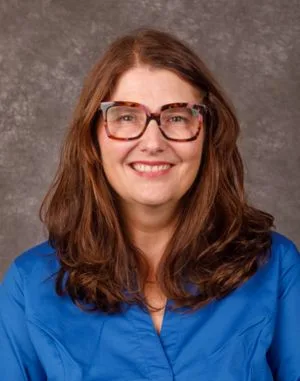
Crystal Cook-Marshall, Ph.D.
From her roots deep in Appalachia, to the streets of Harlem, to the hills of Hollywood, Crystal Cook Marshall, Ph.D., makes it a point to find out what is needed and how to address it in a practical manner.
“That’s where I really excel, I guess,” said Cook Marshall, director of NC AgrAbility and agromedicine coordinator for Cooperative Extension at N.C. A&T. “What I’m good at doing is coming in and assessing what needs to happen.”
Through NC AgrAbility, Cook Marshall helps agricultural workers with disabilities find ways to stay productive through adaptive technology, modifications to work environments and other accommodations. Her work also supports the Farm and Ranch Stress Assistance Network-NC, which connects farmers with mental health resources.
“There’s almost no other group that we ask so much from,” Cook Marshall said. “They put their physical, and financial, and collateral, and family, at risk in order to produce food for someone else. Nobody else in any other sector would do all this or put up with being expected to do all of that.”
Cook Marshall, 54, grew up “around cows and coal” in Bluefield, West Virginia. The daughter of a sharecropper mother and a printer father, she jokes that she would have been voted least likely in high school to go into farming.
“My first real job out of college was working in a youth program in East Harlem,” said Cook Marshall, who graduated with a B.A. in history from Barnard College. During this time, she met Sylvia Rivera, who came to be a mentor.
“She’d come out of Jesse Jackson’s Rainbow Coalition, and she left a deep impression around service work and having respect for the people … and deep listening,” said Cook Marshall, who went on to get an MST in Education from The New School for Social Research, an MFA from Antiock University-Los Angeles and eventually a Ph.D. in Science and Technology Studies from Virginia Tech.
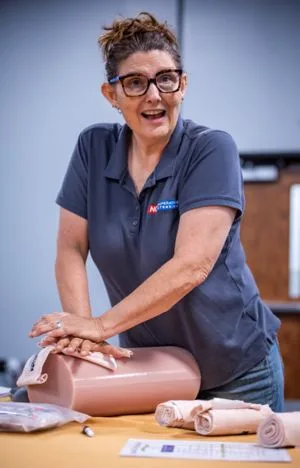
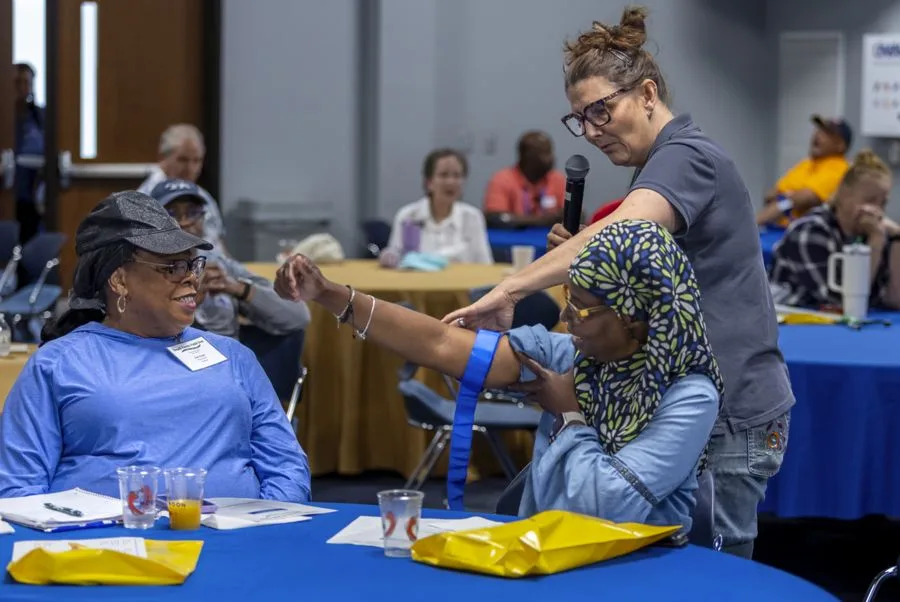
Extension Associate Crystal Cook-Marshall, Ph.D., leads a workshop on stopping bleeding during Small Farms Field Day at the N.C. A&TSU farm in Greensboro.
“I was brand new to understanding Hollywood,” Cook Marshall said. “I had to learn an entire ecosystem of an industry in a very short amount of time — and then figure out who the actual decision-makers were and how we were going to reach them.”
She zeroed in on 200 key people in children’s media in Hollywood and invited them to a symposium. “We figured out the gatekeepers for the things that we wanted changed, Cook Marshall said, noting that those core relationships she built while at the institute continue today.
Mark Blevins, Ed.D., Extension assistant administrator for agriculture and natural resources, said Cook Marshall’s considerable circle came into play after Hurricane Helene devastated western North Carolina.
“I've seen her, immediately in the wake of Helene, getting resources from networks that she had been developing over years,” he said. “She was able to bring those resources through thick and thin, over mountains, through valleys, with airplanes and helicopters and ATVs, to get them to people that needed them.”
Cook Marshall said she used the same skills she honed in Hollywood when she returned to the Appalachian region. She was named a National Science Foundation Graduate Fellow, got her doctorate at Virginia Tech and set to work understanding the energy sector and figuring out what besides coal production could drive the rural economy. Her book, “Big Rural: Rural Industrial Places, Democracy, and What Next,” examines the rural industrial space and what strategies might be employed to improve the lives of its residents.
Cook Marshall’s examination of how to reinvigorate mountain agriculture eventually led to her employment with Cooperative Extension at N.C. A&T. She also became a master goat herd and raises sheep on Pockerchicory Farms, a sustainable farm she owns with her husband, Edward. The couple has an 11-year-old son.
The role of women in farming is often overlooked, Cook Marshall said, because they may not be working in the fields. Yet, women are doing the taxes, handling the bookkeeping, processing the food, marketing the products — “making all of these other things happen,” Cook Marshall said. “That’s farming.”
She noted, too, that women are increasingly getting into the production side if farming. “One in three farmers in North Carolina is now female,” Cook Marshall said. “So, they’re doing all of that (back-end) work plus learning the ins and outs of production.”
It’s these and other small-scale farmers who inspire Cook Marshall to continue her work seeking the best, most practical ways to meet their needs.
“Farmers are radically undervalued and not planned for well in our system, so anytime I can connect with people who are farming and keep them doing it — that’s what keeps me doing this.”