“Hungry people are mean people. I’ve seen it in my travels around the world. It’s real,” Commissioner Troxler told a crowd of students at his first forum of the semester.
N.C. Agriculture Commissioner Steve Troxler paid a visit to N.C. A&T’s College of Agriculture and Environmental Sciences to discuss the state of farming, agribusiness, and food security in the wake of the pandemic and the war in Ukraine.
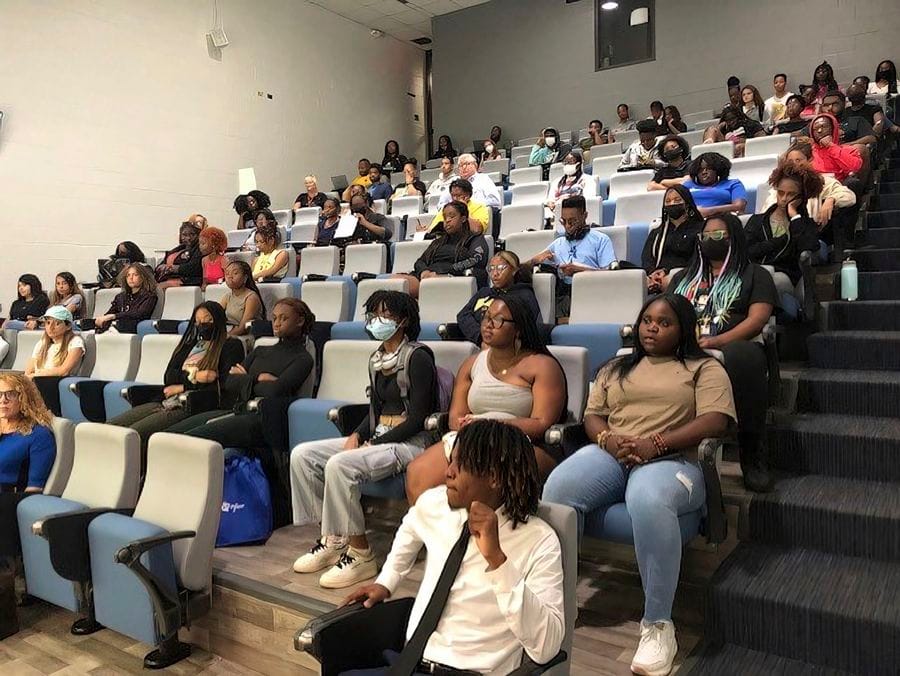
Troxler spoke at the first in a series of professional development seminars this semester in Webb Hall, held in-person after two previous years of virtual sessions.
“I am so glad to finally be here in person today,” said Troxler. “While we have been so blessed to have the technology to survive the pandemic and be able to continue, nothing replaces eye contact and be able to speak face to face.”
In a session called “Looking into the Future of Agriculture and Food,” Troxler illustrated ways that current world events and conditions impact agriculture.
“I want to try to help you get out of your backyard and help you see the things that are not only influencing agriculture, but also your life in the world,” Troxler said.
Framing the discussion around a video lecture by geopolitical strategist Peter Zeihan, Troxler dissected the video’s talking points and opened room for students to offer their interpretations or comments.
“I was sent this video by friends at Eastern Carolina University, and I was asked to take a look at it just to see what I thought,” said Troxler. “I will not tell you that the things he says here are absolutely fact, or true. But it starts you on the path of thinking about ‘what if?’ and how these things are connected.”
Filmed June 30 at Iowa State University, Zeihan’s lecture, “Agriculture at the End of the World”, discusses the impact of COVID-19, the Russian invasion of Ukraine and issues with China’s manufacturing supply chains on global oil and gas exports, inflation, food supply and crop production.
“I think you’ll understand that the United States does not operate in a vacuum,” said Troxler. “Everything is pretty much interconnected now, and it goes from local foods to the global export of agricultural products from around the world. When the pandemic hit, we had supply chain problems, and we started to have problems with the very products that we had to have to produce crops. My first thought was, ‘This is going to starve people in certain parts of the world.’ ”
Troxler said that with lack of resources and proper supply chains, food insecurity could cause political unrest among citizens of other countries.

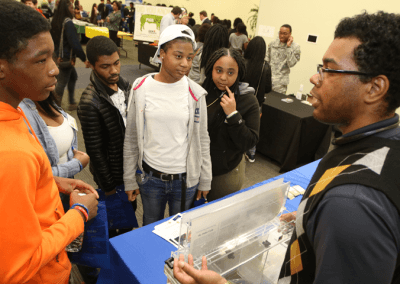
CAES Dean Mohamed Ahmedna, right, joined students in welcoming Comm. Steve Troxler to campus for his first in-person forum of the year.
“Hungry people are mean people. I’ve seen it in my travels around the world. It’s real. Even with food security in the United States - we know the value of agriculture in this country, but there is still food insecurity.”
On the topic of suitable energy sources for agriculturalists, Troxler said that while agriculture currently depends on diesel fuel, natural gas and nuclear power are potentially cost-saving options.
He also added cautions: while electric vehicles, as a current trend, can lessen fossil fuel dependence, they will require a proper grid network to maintain charging, one that has yet to be expanded, he said.
“When you start talking about energy, energy crises and the price of energy, it comes right to the farmland and comes right to the grocery store,” said Troxler. “It needs to be figured out one way or another.”
At the end of the seminar, one student asked about a potential economic collapse in China due to import disruptions and a diminished workforce. Troxler replied that using the “red button”, or a nuclear deterrent, has been a bargaining tool for countries like China and Russia to leverage in trade discussions.
“I can tell you that not only is Russia moving into the Ukraine out of necessity,” said Troxler. “China has a big presence in Brazil, where there is a lot of fertile land. They also have a big presence in Africa, and Africa is one of the unknowns as far as food production. We know the soil types and climates there will produce good food. But the question is political stability and imports and the ability to purchase those imports.”
Troxler called on students, as “future leaders of North Carolina and this country,” to help imagine solutions and challenge status quo.
“You need to learn to do what government is and is not doing now,” he said. “Be a visionary, not a reactionary.”