CaesNews

Where Science Meets Society

Logo featuring the letters "A" and "T" in blue and gold, representing North Carolina Agricultural and Technical State University.

CaesNews

Where Science Meets Society

Home

Sign up for the Newsletter

Farmers Helping Farmers: Grant to Build Online Assistance Network

|

Four men stand together outdoors in a rural setting, smiling at the camera. They are surrounded by a group of people in the background, some wearing traditional attire. The sky is overcast, and the landscape features grassy fields and trees.

Professor Osei Yeboah, center, works with limited-resource farmers all over the world, including these in Ghana. He has been awarded a U.S. Department of Agriculture grant to build a one-stop online network that will provide peer-to-peer technical assistance to socially disadvantaged and veteran farmers and ranchers in North Carolina and Georgia. 

Farmers, like most of us, might not always pay attention to every word of a presentation. But farmers do listen to one another, and a new platform will help them connect, communicate and share information to improve their land, their yield and their prospects.

Portrait of Osei-Agyemang Yeboah, Ph.D., wearing a dark pinstripe suit, white shirt, and patterned tie, smiling against a white background.

Osei-Agyemang Yeboah, Ph.D.

Osei-Agyemang Yeboah, Ph.D., a professor and researcher in North Carolina A&T State University’s College of Agriculture and Environmental Sciences, was recently awarded a U.S. Department of Agriculture grant to build a one-stop online network that will provide peer-to-peer technical assistance to socially disadvantaged and veteran farmers and ranchers in North Carolina and Georgia.

“This new website we are building will add in-person and virtual training, and enhance information-sharing among this client base,” said Yeboah, a professor of agribusiness and international trade. “Farmers, ranchers and especially veterans often learn more from themselves than what we provide in a classroom setting. This peer-to-peer platform will be another avenue for them to be able to digest the material we present.”

The platform will be a digital repository for existing and new hands-on training materials and presentations by CAES faculty on multiple topics, including climate-smart agriculture, soil and water conservation practices, recordkeeping and farm accounting, business and financial planning, agricultural entrepreneurship, marketing, heirs property retention, transition services for beginning farmers and AgrAbility services for farmers and veterans with disabilities. It also will serve as a virtual meeting place for Socially Disadvantaged Farmers, Ranchers, and Veteran Farmers (SDFRVs). Yeboah anticipates that the website could be up and running by the end of the year.

Yeboah will receive a three-year, $746,950 grant to carry out this outreach and assistance project. It is being funded by the 2501 Program, administered by the USDA’s Office of Partnerships and Public Engagement, to support veterans involved in agriculture and farmers and ranchers from underserved backgrounds. In October, the 2501 Program announced it would award $22.6 million to 31 grantees, including Yeboah, in fiscal year 2024.

According to Yeboah, many socially disadvantaged producers have historically lacked access to USDA programs and services and low-interest Farm Service Agency loans. This lack of support and capital contributed significantly to Black farmers in the United States losing more than $300 billion worth of acreage during the 20th century and further widening a national racial wealth gap.

Farming and ranching increasingly requires specialized business knowledge, Yeboah added. That means producers require support — from the government, from university faculty and from their peers — to improve production, yields and profits.

“Agriculture is very risky, and individual farmers cannot acquire all of the knowledge they need by themselves,” Yeboah said. “With this grant we can bring them together and have them interact with one another on this platform.

“At the end of the day,” Yeboah added, “this project is about technical assistance and increasing access for farmers and ranchers to local, district and regional USDA offices and to USDA programs and gain knowledge about available programs so they can acquire land, improve their land and become better and more productive farmers.”

Would you like to learn more about N.C. A&T State University?

Founded in 1891 in Greensboro, North Carolina, N.C. A&T is the nation’s largest historically Black university and a premier 1890 land-grant doctoral research institution. Home to more than 14,000 students, A&T is nationally recognized as the top public HBCU in the country and the number one producer of Black graduates in engineering and agriculture. With over $2.4 billion in annual economic impact, the university combines rigorous academics, pioneering research, and a vibrant campus culture to prepare the next generation of global leaders. 

Read more CAES News

Four CAES Students Named Multicultural Scholars

Four CAES Students Named Multicultural Scholars

Four CAES freshmen pursuing degrees in the food, agricultural, natural resources and human sciences are receiving funding, mentoring and skill-building opportunities thanks to a grant from the Higher Education Multicultural Scholars Program, a national, competitive grant program offered through the USDA’s National Institute of Food and Agriculture.
N.C. A&T Cooperative Extension Responds to Hurricane Helene

N.C. A&T Cooperative Extension Responds to Hurricane Helene

Hurricane Helene cut a devastating swath across Western North Carolina and through the state’s $111 billion agricultural economy.
“Turn It Into a Garden”: Try Healthy Partners on County-wide Edible Landscape Project

“Turn It Into a Garden”: Try Healthy Partners on County-wide Edible Landscape Project

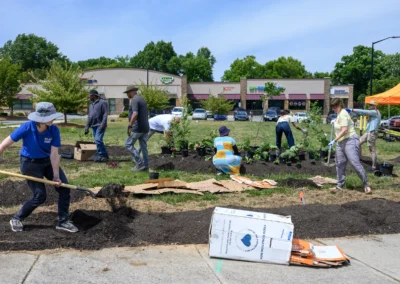
Cooperative Extension at North Carolina A&T’s Try Healthy program is one of many partner organizations working to bring accessible food to the Guilford County community, straight from the ground.
November news and notes

November news and notes

Anthony Hooks spent Nov. 6, his last day as coordinator of the University Farm's Poultry Unit, in the most fitting way possible: sharing his passion for agriculture with students in an animal science lab. He is retiring after more than 30 years of service to the university and its students.
No results found.