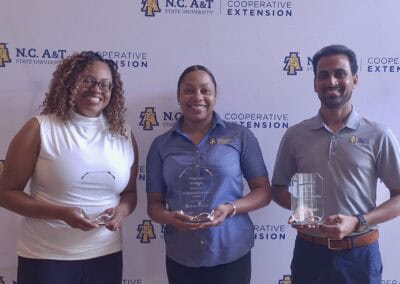
Community leaders from across the state came to Raleigh this fall to learn new ways of empowering themselves and the organizations they represent at the 2024 Grassroots Leadership Conference, hosted by N.C. A&T Cooperative Extension.
Workshops on such topics as ways to use artificial intelligence to strengthen grassroots programs; how to re-engage marginalized populations in communities; and how to create and pitch a business idea engaged more than 100 attendees, all centering on the theme of understanding common issues and preparing for the future.
“The basis of our common work is to be involved in the community,” said organizer Michelle Eley, Ph.D., community and economic development specialist at N.C. A&T Cooperative Extension.
“Grassroots Leadership Conference is an essential program because it gives us an opportunity to connect with community stakeholders and grassroots leaders. Although our program is very theme-centered, each year, we strive to offer topics that help build community capacity while equipping individuals and organizations with the skills, knowledge, and resources necessary to solve their problems and sustain progress. This year, it was essential to create space in the program to listen to conference attendees to understand better how we can expand our programming footprint and offer technical support,” she said.
A panel discussion on understanding common issues brought out the need to engage with communities directly, and not always in ways that organizers have planned.
“The community leaders aren’t always who you think,” said Shoneca Kent, Director of Housing Initiatives at the Institute Community Development Initiative. “The area expert may be an elderly woman who has tremendous insight and knowledge of the community and commands tremendous respect. The challenge is to empower people like her to do all that they can. You’re not always providing solutions, but removing barriers for others to provide solutions.”
Non-traditional leaders “leap out at you, if you’re paying attention,” said Patrick Woodie, president and CEO of N.C. Rural Center. “You’ll see who has a fire in the belly. Be present in the community and go to them; people open up in person. We can use fancy analytics, but if you can’t identify the story, how can you help the story?”
Another commonality is that communities are broadening, including many races and nationalities where before, only one or two may have lived., Woodie said. Being able to collaborate, identify common goals and focus energies can be challenging, particularly given the development pressures many rural communities are experiencing.
“North Carolina is second in the nation in decline in agricultural land, but we still have a large number of small communities and little towns,” said Michael Butchko of Neighbor Works American.
In a popular session about the use of artificial intelligence, 4-H Community Specialist Mark Light, Ph.D., of N.C. A&T Cooperative Extension led the group in an AI exercise to show the ways Alexa, Siri, Chat GPT and other “assistants” move toward giving better results.
“Extension is the original Chat GPT,” he said. “Tech is here to stay. And, it can make rural communities safer and help people have healthier places to live. The more you tell it, the faster it learns”
The session concluded with a roundtable discussion about ways to enhance programs.
“We need ideas for improvement and ways to stay connected,” N.C. A&T Extension Administrator M. Ray McKinnie said. “Stay true and authentic to yourself. What you do has value, and at some point, when your organization is called upon, you’ll complete the picture.”