CaesNews

Where Science Meets Society

Logo featuring the letters "A" and "T" in blue and gold, representing North Carolina Agricultural and Technical State University.

CaesNews

Where Science Meets Society

Home

Sign up for the Newsletter

NIFA SEEKS APPLICATIONS FOR SMALL BUSINESS INNOVATION RESEARCH – PHASE II

|

The U.S. Department of Agriculture’s (USDA) National Institute of Food and Agriculture (NIFA) is seeking applications for the Small Business Innovation Research (SBIR) – Phase II program from previous Phase I awardees.

The SBIR program is carried out in three separate phases. Phase I determines the scientific or technical feasibility of ideas submitted by applicants on research topic areas solicited. Phase II requires a more comprehensive application, outlining the proposed effort in further detail. Phase III’s focus is to stimulate technological innovation and return on investment from research carried out in Phases I and II.

Applications are currently being solicited for Phase II. Eligible applicants include previous SBIR Phase I awardees who have not applied for Phase II support. A Phase I awardee may only apply for a Phase II grant once. If a Phase I awardee was unsuccessful in receiving a Phase II grant with a previous application, then the awardee is not eligible to resubmit the proposal under this program solicitation.

The deadline for applications is 5 p.m. March 8, 2018. See the SBIR Phase II Request for Applications (RFA) for details.

The SBIR program was established under the Small Business Innovation Development Act of 1982 to address scientific problems and create opportunities in agriculture that could lead to significant public benefits. Additionally, the program stimulates technological innovations in the private sector and strengthens the role of federal research and development in support of small businesses.

NIFA’s mission is to invest in and advance agricultural research, education, and extension to solve societal challenges. NIFA’s investments in transformative science directly support the long-term prosperity and global preeminence of U.S. agriculture. To learn more about NIFA’s impact on agricultural sciences, visit www.nifa.usda.gov/Impacts, sign up for email updates, or follow on Twitter @USDA_NIFA, #NIFAImpacts.

Would you like to learn more about N.C. A&T State University?

Founded in 1891 in Greensboro, North Carolina, N.C. A&T is the nation’s largest historically Black university and a premier 1890 land-grant doctoral research institution. Home to more than 14,000 students, A&T is nationally recognized as the top public HBCU in the country and the number one producer of Black graduates in engineering and agriculture. With over $2.4 billion in annual economic impact, the university combines rigorous academics, pioneering research, and a vibrant campus culture to prepare the next generation of global leaders. 

Read more CAES News

Fashion Nova, Megan Thee Stallion Give $25,000 to Fashion Program

Fashion Nova, Megan Thee Stallion Give $25,000 to Fashion Program

Popular fashion retailer Fashion Nova and rapper Megan Thee Stallion rolled out the red carpet for the fashion merchandising and design program at N.C. A&T recently with a surprise donation of $25,000.
NRED Student Establishes Book Scholarship to Give Back, Pay It Forward

NRED Student Establishes Book Scholarship to Give Back, Pay It Forward

Environmental studies major Maya Johnson won't graduate until May, but she's already giving back. Farm Credit/National MANRRS VIP Scholar herself, Johnson has established a scholarship to help high school students from her hometown of Bowie, Maryland, buy books, an overlooked – but costly – part of the freshman experience.
Back to Belize

Back to Belize

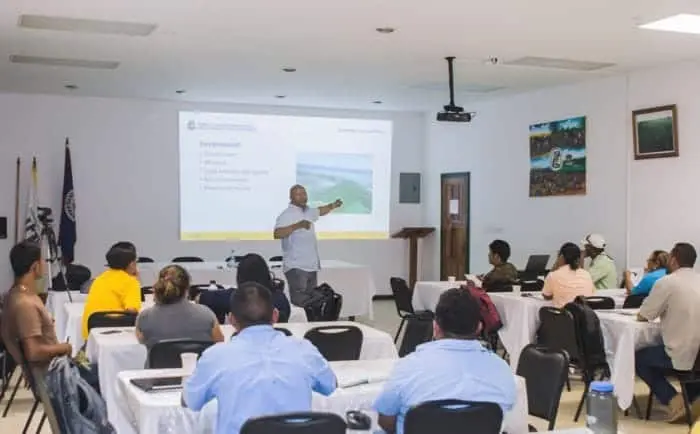
In agriculture, it’s not just the science but the inter-personal connections that matter. That’s why a group from the CAES has traveled, for the past three summers, to the small, Central American country of Belize: to make connections.
December News & Notes

December News & Notes

The Department of Animal Sciences has received a $6,820 donation from the US Poultry & Egg Harold E. Ford Foundation.
No results found.