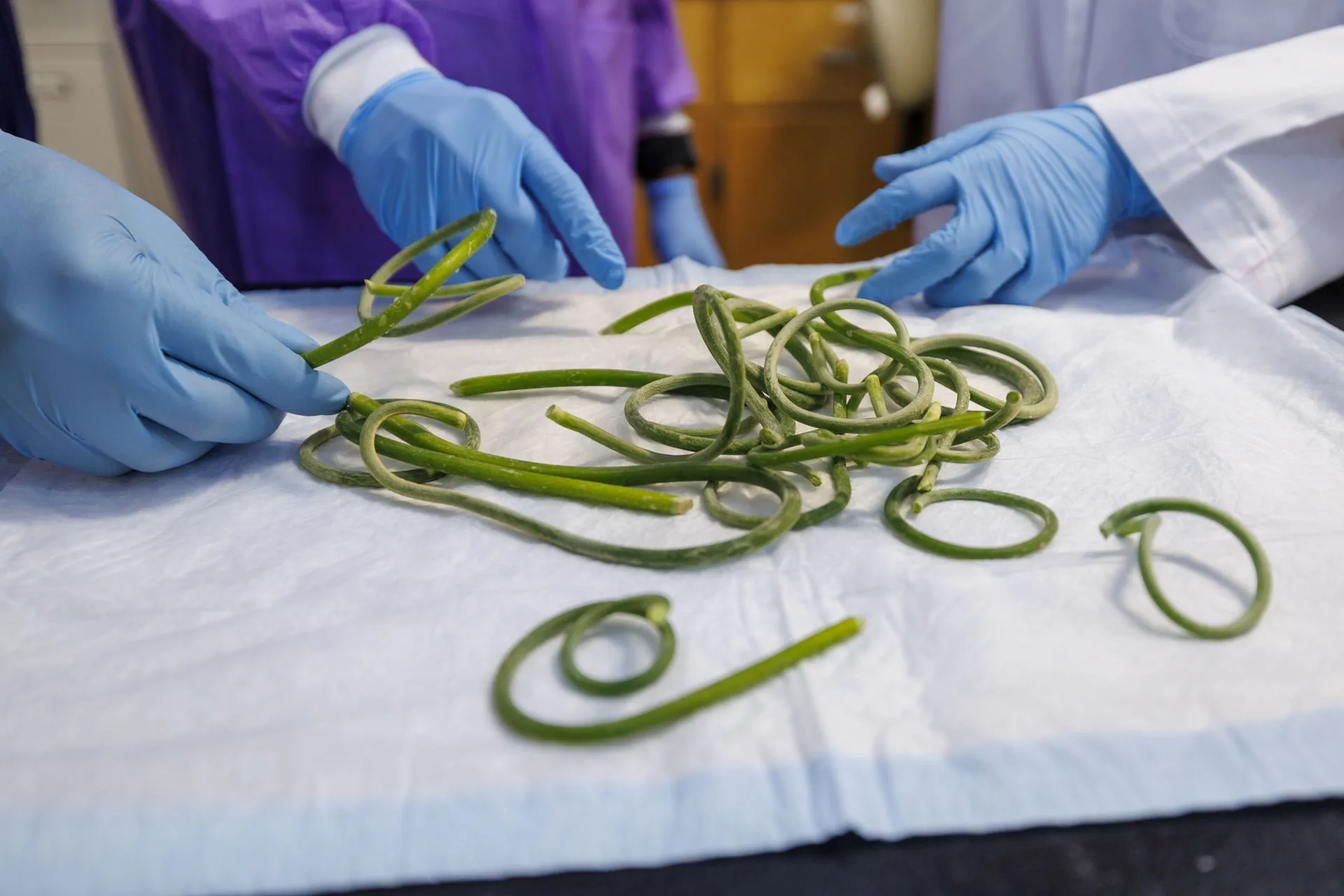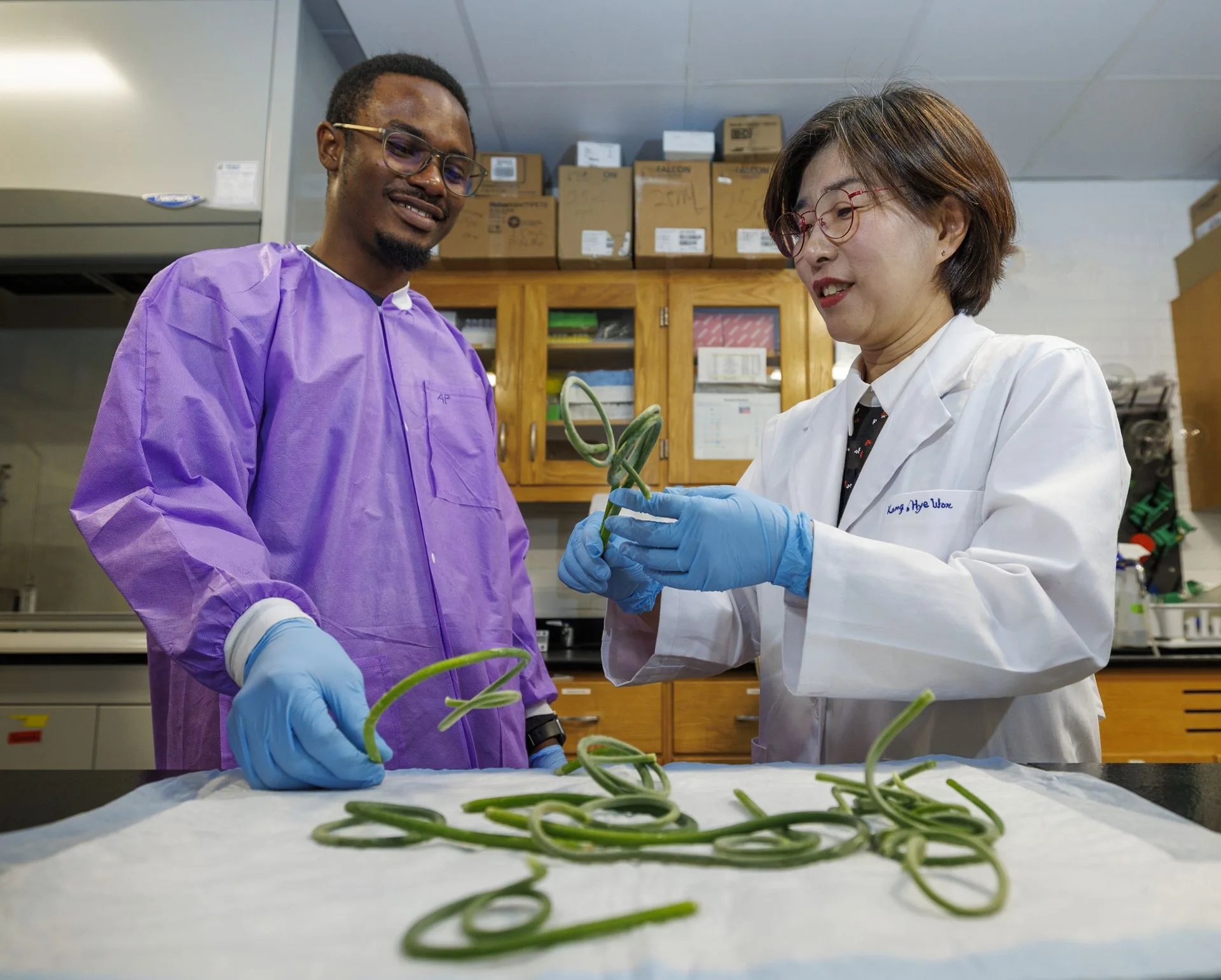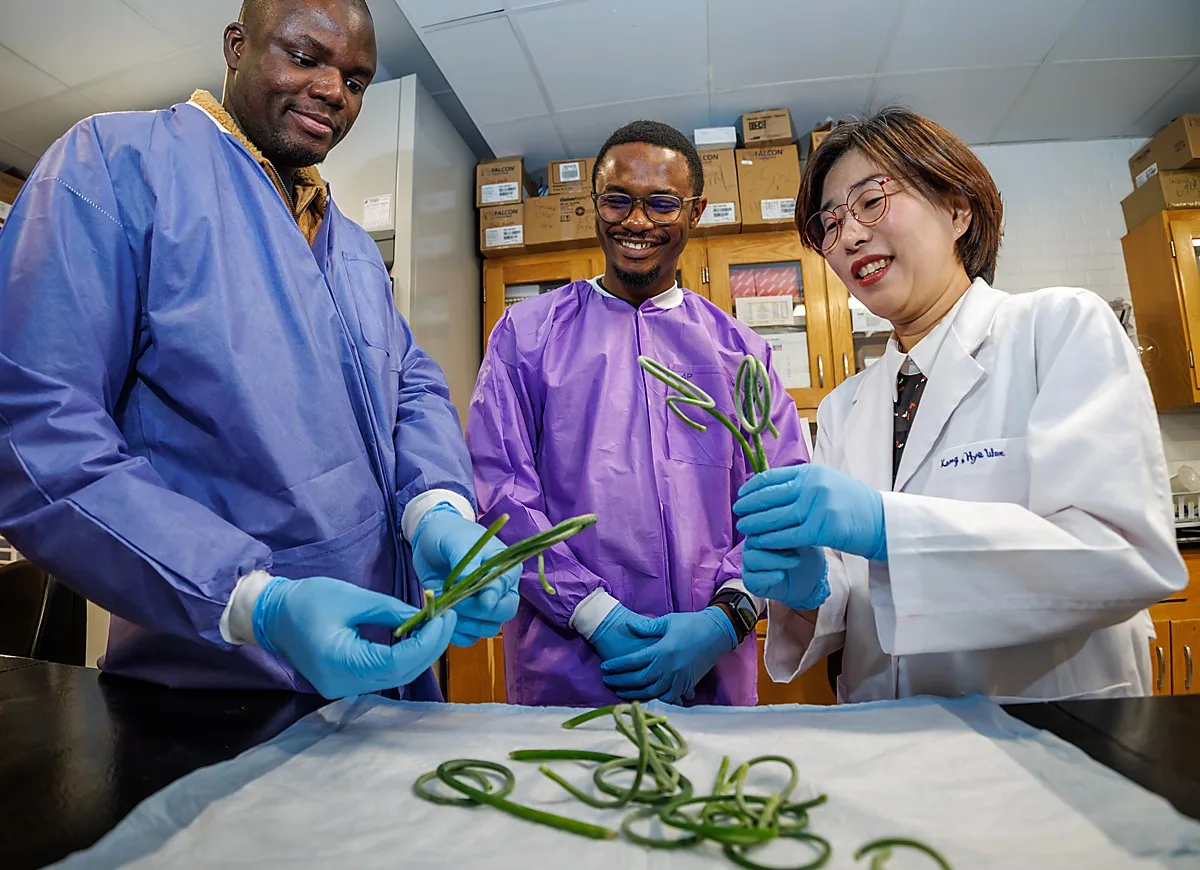
While the health benefits of garlic are well known, a part of the plant that is often thrown away by U.S. farmers may help fight obesity and improve the overall health of the intestine.
That’s what N.C. A&T’s Hye Won Kang, Ph.D., hopes to prove in her research using the curly green flower stalks — called garlic scape.
Kang, a professor of food and nutritional sciences in the Department of Family and Consumer Sciences, recently received a $500,000 USDA NIFA Capacity Building Grant for the research.
Using a type of garlic called music, which grows well in North Carolina, Kang is studying its effect on the intestine. “We’re trying to see whether garlic scape can inhibit pancreatic lipase, which breaks down fat and allows it to be absorbed into the body,” Kang said. Too much activation of this digestive enzyme secreted by the pancreas can lead to obesity, she said.
In collaboration with Kristen L. Rhinehardt, Ph.D., associate professor in A&T’s Computational Data Science and Engineering Department, a computer simulation will be conducted to analyze the inhibitory effect of garlic scape.
Kang’s three-year study also aims to determine if the bioactive compounds in garlic scape can impede the development of intestinal inflammation.
A high-fat diet can cause inflammation in the intestine, thus weakening its function and allowing bacterial toxins called lipopolysaccharides (LPS) to enter the bloodstream. Elevated levels of LPS in the blood are associated with chronic conditions such as obesity, insulin resistance, non-alcoholic fatty liver disease and inflammatory bowel disease.
The research will use two different cells: HT29, an intestinal cell that makes mucus, and Caco-2, an intestinal epithelial cell that is absorbative. Researchers will make a coculture of the two cells to mimic the human intestinal cell structure and treat it with LPS. Then they will introduce garlic scape extract to determine if its bioactive compounds reduce the inflammation.
Researchers will measure different inflammatory markers and the tight junction protein, which is the cell-to-cell binding.
“We want to know how our sample inhibits the inflammation by regulating this tight junction protein,” Kang said. “The tight junction has to be increased — so it is more tight — and then the inflammation markers cannot pass through into the blood.”
Preliminary testing in mice has yielded encouraging results for its potential success in humans, she said.
One of co-principal investigators, Sun-Ok Lee, Ph.D., professor in the Department of Food Science at the University of Arkansas, will isolate the gut bacteria in healthy human subjects’ feces. She will culture it, treat it with the garlic scape extract and then analyze the samples to see how it changes the composition of the microbiome.
Abeer Hasan, Ph.D., associate professor in A&T’s Department of Mathematics and Statistics will statistically analyze Lee’s microbiome data.
If the link between garlic scape and a healthy gut is promising, Kang said researchers will encourage people to eat garlic scape to fight obesity.
Garlic scape, which is often eaten in Asian countries, contains a lot of fiber and has similar bioactive compounds as garlic bulbs, but doesn’t stink as much, Kang said.
“That’s a fresh, edible vegetable, I just sauté it with soy sauce. When you sauté it, it’s got a sweet taste,” said Kang, adding that it can be pickled as well.