
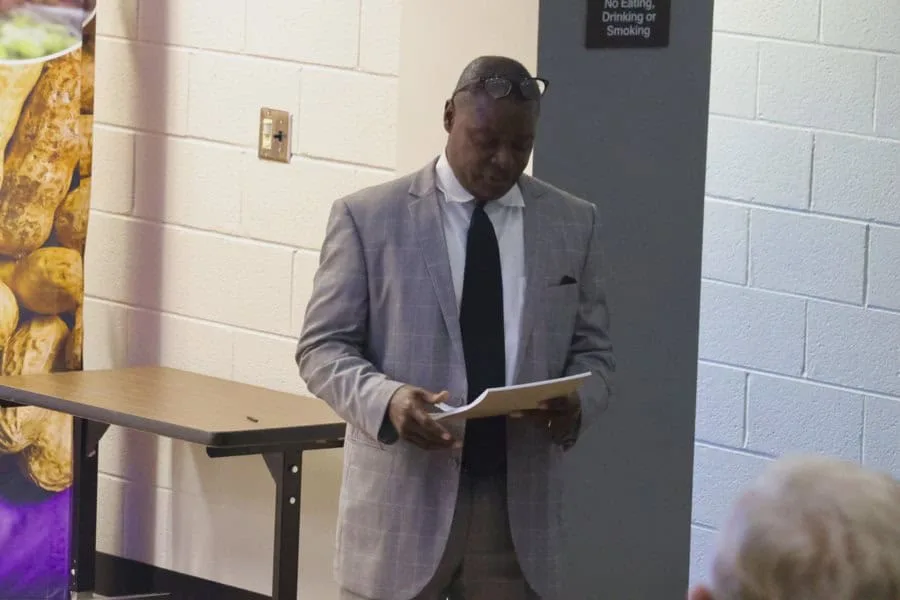
North Carolina’s agricultural commissioner and members of several food agencies in the state visited the College of Agriculture and Environmental Sciences in the second of a three-part lecture series on agriculture and policy issues.
This month’s lecture, held Oct. 25 in Webb Hall’s auditorium, focused on local food purchasing programs and the opportunities they present to small, socially disadvantaged farmers.
“The partners that we have today will explain their roles in how this department administers these programs,” said Troxler. “We’ve had a focus on local foods for a long, long time in the Department of Ag and I think COVID had brought more focus on that than we’d previously seen because of supply chain issues. We’ve taken that opportunity to move forward that we’d had before.
Among the initiatives listed was the Local Food for Schools (LFS) Cooperative Agreement Program. USDA awards up to $200 million to states for food assistance purchases of domestic local foods for distribution to schools.
Walter Beal, director of the N.C. Department of Agriculture’s Food Distribution Division, spoke about the state’s Farm to School program, which delivers fresh, local produce to qualifying schools – and how 2022-23 marked a “record-breaking year” for the program.
Walter Beal, director of the N.C. Department of Agriculture’s Food Distribution Division, said that 2022-23 was a “record-breaking year” for the program.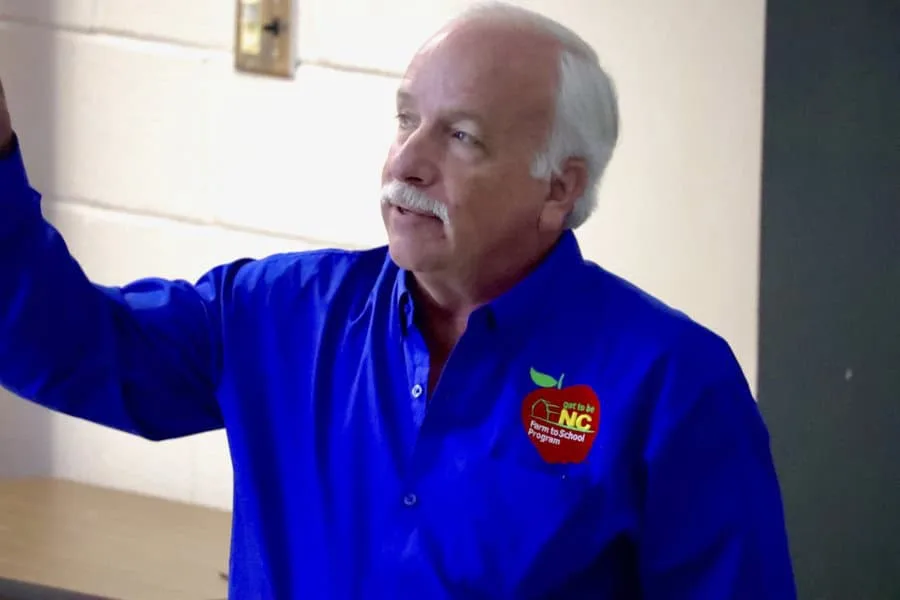
“This year, over $880,000 worth of product was directly picked up and directly delivered to the schools by us,” said Beal. “We also have a co-op, through the US Department of Defence Produce Merchandising Office and FFAVORS (Fresh Fruits and Vegetables Order Receipt Sytem), that delivered to the schools, too. All total last year, $2.5 million worth of products from North Carolina farmers went directly to your schools.”
According to Beal, 85 out of 100 counties participate in the program.
“Those numbers are great,” said Beal, “but we want to see 100 total.”
Roland McReynolds, executive director of the Carolina Farm Stewardship Association, discussed the non-profit’s FarmsSHARE program - an alternative food distribution model that allocates public and private funding to food hubs across the state to purchase from local growers – and how it benefits food-insecure communities and minority, small-scale farmers.
“We work with food hub businesses that are community-based, food distribution businesses that work in produce and proteins across the state,” said McReynolds. “These tend to be grassroots businesses, some are non-profits, some are run by local government agencies, some are private for-profit businesses. We’re able to funnel this funding through these businesses for them to get that fresh food from small, local farms back out to those same communities. It’s communities feeding themselves and that’s music to our farmer-members’ ears.”
Mike Darrow, executive director of Feeding the Carolinas, spoke to the students about the USDA’s Local Food Purchasing Assistance Program (LFPA Plus) and how their organization utilizes the grant to service food banks in North and South Carolina.
“The primary focus of this grant is to support local growers and local producers economically,” said Darrow, “and secondarily is to fight food insecurity.”
The last speaker, Archie Hart, director of the N.C. Department of Agriculture’s Small & Minority Farms Program and an N.C. A&T alumnus, spoke about the growth in diversity in small farm agriculture.
“Over the last 10 years, farming has become a more inclusive group,” said Hart. “It’s a group that now consists of Black farmers, Native farmers, Hispanic, women farmers, Asian farmers, and more. Historically, small farms were synonymous with Black producers.”
Hart also said that academic and outreach programs at N.C. A&T and other 1890s universities have helped in assisting minority farmers and food insecure locations.
“When you talk about land-grant institutions, you talk about the three pillars that make up those institutions: research, education, and outreach,” said Hart. “In order for these (food preparation) programs to move forward, there has to be a partnership with these 1890s institutions.”