The College of Agriculture and Environmental Sciences hosted visiting Malian scientists studying post-harvest agriculture as part of a collaboration with the U.S. Agency for International Development
In the spirit of USAID’s New Partnership Initiative (NPI), CAES hosted four USAID-sponsored university professors and scientists from Mali – a landlocked country in West Africa – on a two-week exchange visit from June 3-14, 2024. The visit was financed and organized though USAID Mali’s Feed the Future Sene Yiriwa – South activity, a five-year activity working to empower Producer Organizations in Mali’s Southern zone, whose lead implementing partner is the Research Triangle Institute (RTI) International in Research Triangle Park, North Carolina.
Project PI and director of the Center for Post-Harvest Technologies Leonard Williams, Ph.D., said the visit “served to diversify USAID’s partner base and help foster impact on Malian agriculture by creating new relationships between African and HBCU institutions such as N.C. A&T.”
“What we hope our guests take away from their visit is to help identify key drivers and technologies that can be used to help develop sample curriculum for Extension services and rural development throughout Mali,” said Williams. “This includes the establishment of research and training cooperatives with several N.C. A&T CAES team members.
According to a March 2024 Cadre Harmonisé analysis (the unifying tool that analyzes current and projected food and nutrition situations), nearly 1.4 million people across Mali are likely to face Crisis—Phase 3, or worse, levels of acute food insecurity during the June-to-August 2024 lean season, when food is most scarce.
The visiting professors (Drs. Sabake Tianegue Diarra and Aly Kansaye, research assistant Hamidou Senou, and soil fertility researcher Alou Coulibaly) represent the Rural Polytechnical Institute for Training and Applied Research (IPR/IFRA), which is more than a century old and the leading higher educational institution in Mali for the fields of agriculture, livestock, and forestry. Additional delegates representing FTF Sene Yiriwa – South activity included project coordinator Christelle Celestine and deputy chief of party Sheikh Hamid Toure.
The primary focus of the visit was research associated with agricultural commodities important to Mali, such as potatoes, sweet potatoes and peanuts including propagation under tissue culture techniques. According to Williams, the purpose of the visit was for the researchers to learn about “climate-smart agricultural practices and agricultural education training that can help support IPR/IFRA in their activities on the field, research and integration of successful innovations in their academic cursus.”
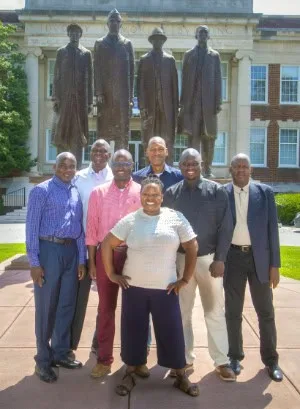
Members of the Mail delegation stopped at the Greensboro Four statue on their campus tour.
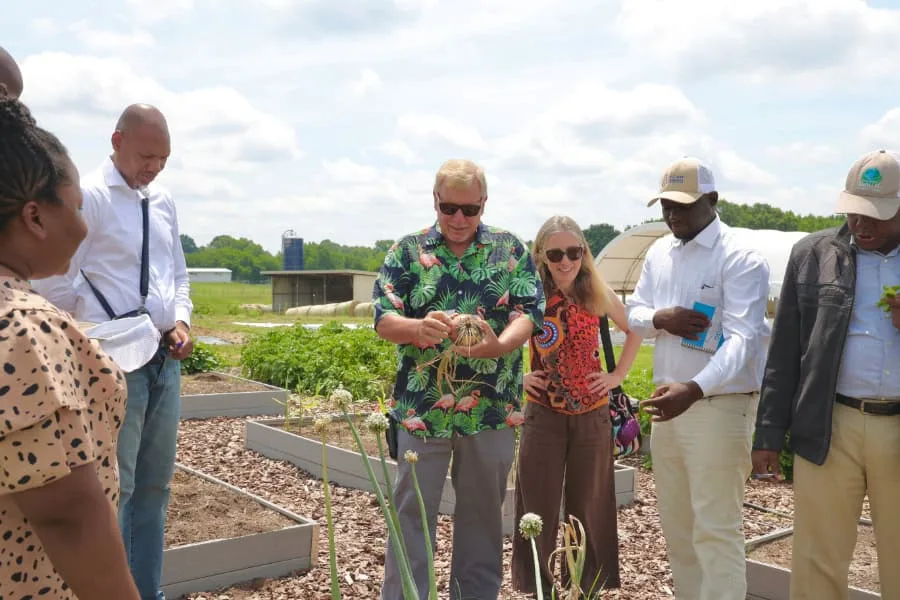
Over the two-week period, the visiting delegates traveled to multiple research stations in North Carolina, listened to presentations on youth development, agribusiness, and food insecurity, as well as a visited Tuskegee University in Tuskegee, Alabama. During their tour of N.C. A&T’s campus, the delegates toured several college facilities, including C.H. Moore Agricultural Research Station, the University Farm’s Student and Community Garden, and post-harvest labs in Carver Hall, labs at the Center for Excellence in Post Harvest Technologies in Kannapolis in addition to cultural visits to the Tuskegee Airman National Museum and the International Civil Rights Center & Museum as part of scheduled workshops with CAES faculty and researchers.
“One of the key takeaways of these visits is the state-of-the-art infrastructure of N.C. A&T State University and in particular the tissue culture laboratories which greatly impressed the IPR/IFRA faculty-researchers,” said Sheikh Toure, deputy chief of party of FTF Mali Sene Yiriwa, RTI International. “This gave our delegates hope that they could collaborate closely with N.C. A&T on sweet potato landraces and provide them with a solution for learning and capacity building of students and research professors through the distance learning mechanism via videoconferencing tools.”
According to Williams, the project team (Odile Huchette; Gregory Goins, Ph.D.; Paula E. Faulkner, Ph.D.; Obed Quaicoe, Ph.D.; Niroj Aryal, Ph.D.; and Bill Randle, Ph.D.) anticipates hosting additional IPR/IFRA delegates next year.