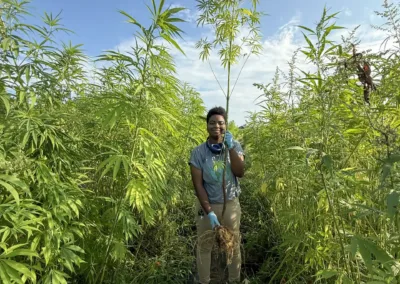
Gregory Goins, Ph.D.
The new chair of the Department of Natural Resources and Environmental Design is no newcomer to N.C. A&T or Guilford County.
Gregory Goins, Ph.D., joins the College of Agriculture and Environmental Sciences after 15 years as a faculty member in A&T’s Department of Biology. His roots in Guilford County go even deeper. He grew up in the Stoney Hill community of Pleasant Garden, where he developed a passion for agriculture and for empowering individuals, families and communities.
“I come from an agricultural community, but in my agricultural community most of the people worked on the farms of larger landowners as tenant farmers or sharecroppers,” Goins said. “It’s always been an interest of mine to find a way for people without access to land to be involved in agriculture. How can they have a greater stake in what they produce?
“That’s how I got involved with controlled-environment agriculture through hydroponics. You can do hydroponics indoors or with small plots. You can have a high yield without needing a lot of acreage. That’s the foundation of why I’m interested in agriculture.”
After graduating from Southeast Guilford High School, Goins earned a bachelor’s in biology at UNC – Chapel Hill. He completed his master’s and doctorate in interdisciplinary crop science at NC State and was a post-doctoral research associate at the University of Minnesota.
Goins is enthusiastic about the opportunities provided by his new position to apply his expertise in both bench and field research and to work even more closely with Cooperative Extension. His involvement with Extension includes collaborating with the Department of Civil, Architectural and Environmental Engineering in 2010 on a curriculum that became the first-ever 4-H National Science Experiment to originate at an 1890 institution.
He also taught hydroponics to teachers during Get STEMed Up: Aggie Educator Institute. Organized by Extension and other campus partners, Get STEMed Up provided a summer professional development opportunity to help teachers from Title I schools effectively teach their students math, science, agri-science and digital learning skills.
In addition to his outreach work, Goins is an active researcher with interests that include rapid detection and remediation of xenobiotic chemicals in local water systems. He also is currently the principal investigator for an NSF-funded INCLUDES (Inclusion across the Nation of Communities of Learners of Underrepresented Discoverers in Engineering and Science) project that improves students’ quantitative skills in STEM across socio-economic divides.
Goins has focused on broadening participation in STEM careers throughout his tenure at A&T. He continues to work extensively with national organizations to re-focus learning outcomes of the traditional methods of science instruction using active, collaborative learning strategies and the creation of problem-based learning problems and materials.
He served as an NSF Program Officer for the Noyce, IUSE, and S-STEM Programs in 2013-2014. In 2010, he was featured by the National Academy of Sciences as a success story looking toward the future of biology education “Beyond BIO2010.”
Prior to becoming a faculty member at A&T, he was a Florida-based NASA research scientist focused on plant space biology and environmental systems. In 2003, he received the prestigious NASA Space Flight Awareness Award for his photosynthesis research conducted on plants flown on the International Space Station.
He has received numerous other awards for his work, including being named a White House Champion of Change in 2015 for promoting student success at HBCUs in biomathematics. In 2013, he received the Outstanding Teaching Award for the College of Arts and Sciences.
His wife, Tonya Gerald-Goins, Ph.D., teaches chemistry at North Carolina Central University. They have two sons, Daniel and Kendall.