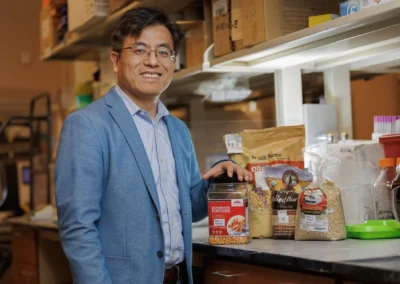
Horticulture researcher Guochen Yang, Ph.D., has spent four decades promoting better health, better crops and instructing the next generation of horticultural scientists. Now, he has achieved “legendary” status, according to his peers.
Yang, a professor in the Department of Natural Resources and Environmental Design, has been named a 2025 horticultural legend, or “HortLegend,” by the American Society for Horticultural Science, a top organization within the profession.
As part of his recognition, Yang, who joined the ASHS in 1988, will take part in a video interview for ASHS reflecting on his career as part of the organization’s annual conference at the end of July.
“For anybody to be recognized by their society or their respective organization means a lot,” said Yang, who is a member of the ASHS. “I – and the other recognized members in ASHS – have spent our lifetimes educating and developing future generations of horticulture professionals.”
Yang specializes in plant tissue culture, or “micropropagation,” and his discoveries in that area have led to two patents for growing Alexandrian laurel, an evergreen ornamental plant. For the past 10 years, he has focused on producing ginger as a potential agricultural commodity for North Carolina farmers.
“Young ginger, which is almost exclusively produced in Hawaii, can bring more than fifteen dollars a pound, conservatively, and each plant easily has the potential to generate one to two pounds of ginger root,” Yang said. “Using tissue-culture propagation, we can produce thousands of plants at once here in North Carolina. After they have factored out expenses, our farmers can make a lot of money.”
Yang says that his upbringing in rural China offered him an early exposure to horticulture and its societal benefits both financial and biological.
“I was born and grew up in the country, so agriculture has always been in my blood, my DNA,” said Yang. “I just really wanted to help myself, my society and the people around me by learning how we can produce better quality crops, better selection of food and, hopefully, promote better health.”
Yang received his bachelor’s degree in horticulture at Jilin Agricultural University in China and his master’s and doctoral degrees at the University of Nebraska-Lincoln. He joined the college in 1994, and currently serves as the graduate program coordinator for the Department of Natural Resources and Environmental Design. Among his students are Ph.D. scholars and research assistants William Lashley, Julia Robinson and Daniel Tetteh.
“I am excited about the future, for horticulture overall,” said Yang. “My biggest rewarding area is working with young professionals like Will, Julia, Daniel, (and former students and current colleagues) Dr. Trequan McGee and Dr. Hannah Talton. They are the future generations of the science of horticulture. I hope that my recognition will have some kind of inspirational role for the younger generation to look at and say, ‘I’m doing something good for the general public.’ ”
Established in 1903, the American Society for Horticultural Science is recognized around the world as one of the most respected and influential professional societies for horticultural scientists. Comprising thousands of members worldwide, ASHS represents a broad cross-section of the horticultural community, including scientists, educators, students, landscape and turf managers, government, Extension agents and industry professionals.